Accounting across Canada
Accounting and Tax Guide for Calgary Businesses
A practical Calgary accounting and tax guide covering records, sales tax, payroll, provincial considerations, and corporate planning.
Sources checked August 20267 min read

What the official Calgary data shows
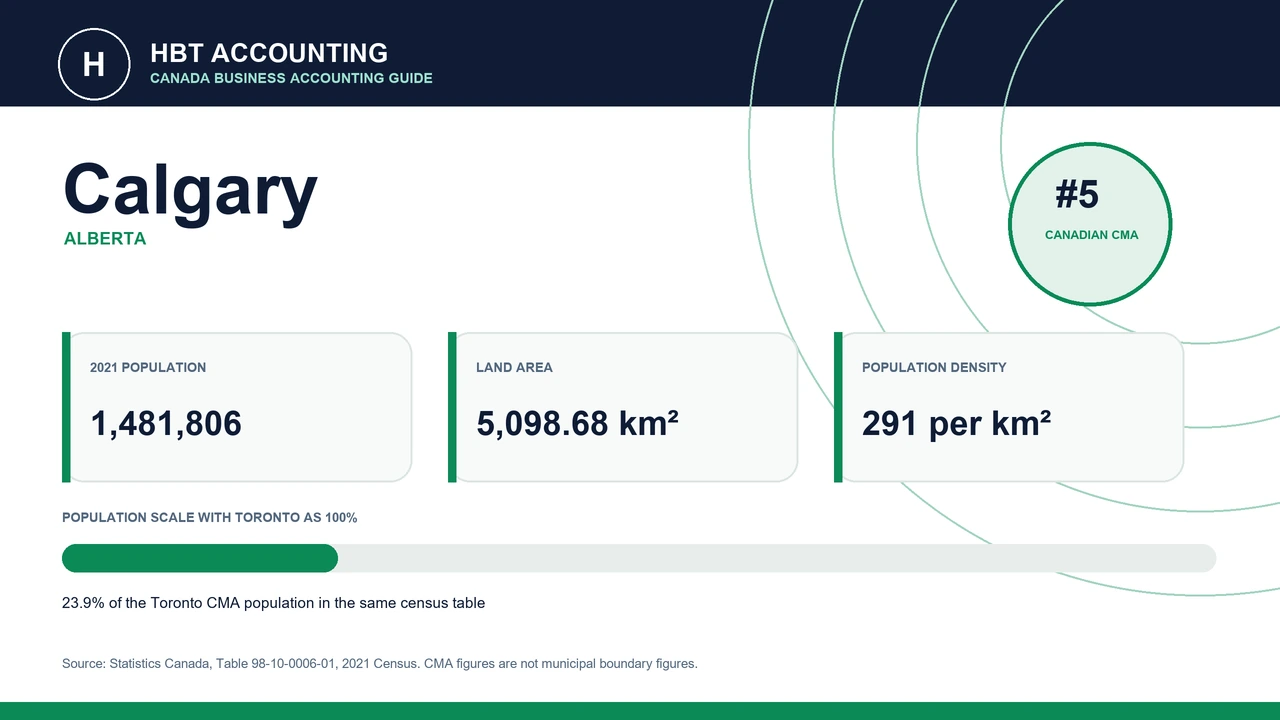
Statistics Canada ranked the Calgary census metropolitan area number 5 among Canadian census metropolitan areas by 2021 population. The official table reports 1,481,806 people across 5,098.68 square kilometres. That is about 291 people per square kilometre. The calculation uses the population and land area in the same official table.
The census figure gives this guide an honest market scale, not a tax conclusion. Two companies in the same region can have different obligations because their entities, customers, employees, registrations, and transaction flows differ. For Calgary, the practical planning theme in this guide is keeping Alberta corporate filings, federal filings, GST, payroll, and owner transactions on one coordinated calendar.
| Measure | Result | How to interpret it |
|---|---|---|
| Population | 1,481,806 | Census metropolitan area, not municipal boundary |
| Land area | 5,098.68 km2 | Land area in the same Statistics Canada table |
| Population density | 291 people per km2 | Calculated from the official population and land area |
| National CMA rank | Number 5 | Ranked by the 2021 population used for this series |
Key points
- Confirm the legal entity, registrations, reporting periods, deadlines, and responsible people before preparing a return.
- Calgary corporations commonly deal with federal CRA accounts and Alberta corporate income tax administration. Alberta does not have a general provincial sales tax, but GST, payroll, corporate filings, and industry specific levies can still require careful records.
- Statistics Canada reported 1,481,806 people in the Calgary census metropolitan area in the 2021 Census. This is census metropolitan area data, not a municipal population.
- HBT Accounting is based at Unit 220, 1830 52 Street SE, Calgary, AB T2B 1N1. This is the firm's Calgary office.
Build the federal and Alberta reporting map
Calgary corporations commonly deal with federal CRA accounts and Alberta corporate income tax administration. Alberta does not have a general provincial sales tax, but GST, payroll, corporate filings, and industry specific levies can still require careful records.
HBT Accounting is physically based in Calgary, so this guide connects the national framework to the firm’s actual office market without inventing another location. The records should reconcile GST, payroll, shareholder activity, and tax instalments to current financial statements. For GST or HST, the applicable rate can depend on the supply and the CRA place of supply rules, not simply the city shown on the invoice. Alberta has no general provincial sales tax; GST still applies where required.
- List every active program account beside the correct legal entity.
- Record the reporting period, filing date, payment date, preparer, and approver.
- Reconcile each tax and payroll control account to the return or remittance.
- Keep the official source and transaction evidence behind recurring tax decisions.
A practical accounting focus for Calgary
The local example is keeping Alberta corporate filings, federal filings, GST, payroll, and owner transactions on one coordinated calendar. This does not claim that every company in the region operates alike. It shows how broad compliance rules can be converted into a record process that reflects actual transactions.
The owner level question is Does the current reporting show enough detail to price work, manage collections, and plan tax payments? In this case, the decision focus is whether the corporation has reliable year to date numbers early enough to plan before its year end. Review that question during the monthly close while contracts, invoices, payroll, and operating decisions are still familiar.
- Coordinate federal and Alberta corporate filing records
- Reconcile GST before each return
- Review shareholder transactions before year end
- Confirm Alberta electronic filing requirements
What to prepare before requesting accounting advice
The fastest way to clarify the next step is to prepare one secure, period specific source package. Include the incorporation or registration records, prior returns, notices of assessment, current trial balance, general ledger, financial statements, bank and credit card statements, payroll reports, sales tax work, financing records, and upcoming deadlines.
HBT Accounting is physically based in Calgary. For a potential remote engagement involving Calgary, the firm must first confirm the entity, province, software, records, professional scope, timing, secure access, and capacity. Start from the Calgary contact page or call +1 (587) 894-7451. The result may be a defined engagement, a request for cleanup information, or a referral when another specialist is better placed to help.
- Use a secure document method for sensitive financial and identity records.
- Separate finalized documents from drafts and identify the reporting period.
- List open notices, late filings, uncertain balances, and time sensitive decisions.
- Agree in writing on responsibilities, information dates, deliverables, and fees.
Official sources
Call or email and we will tell you which records we need and what the work costs, in writing, before anything starts.
Important. This article provides general educational information, not legal or tax advice for a specific business. Rules, administrative policies, rates and deadlines can change. Confirm your facts and current obligations with the responsible government agency and a qualified adviser.