Research briefs
AI Bookkeeping for Small Business in Canada: What It Can and Cannot Do
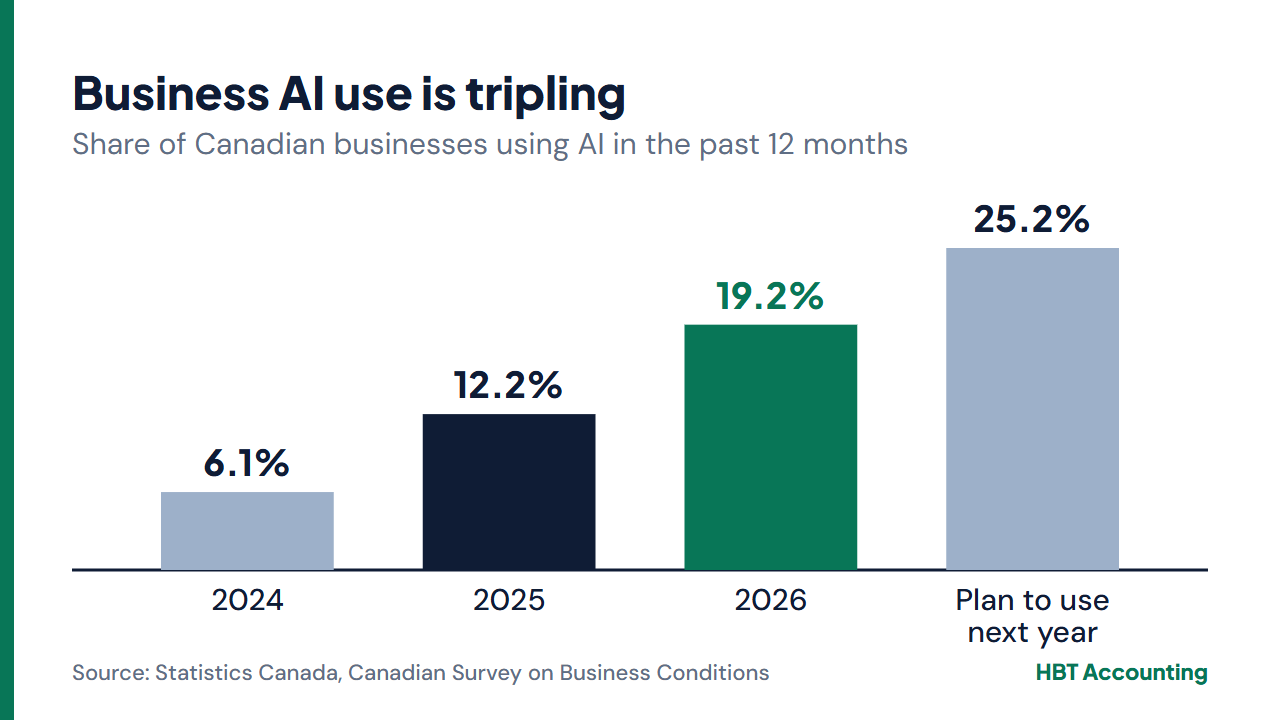
19.2%of Canadian businesses said they used AI to produce goods or deliver services in the 12 months before the spring 2026 survey, up from 12.2% a year earlier, Statistics Canada reported in May 2026.
By HBT AccountingSources checked 6 min read

Key points
- Statistics Canada found 19.2% of businesses used AI in the year to spring 2026, up from 12.2% a year earlier
- A Stanford and MIT study found monthly closes 7.5 days faster, and 62% of accountants worried about AI errors
- The CRA requires records kept for six years, in Canada unless it agrees otherwise, and outsourcing does not move that duty
- Privacy regulators say organizations stay accountable for decisions an AI tool supports and should check its output for accuracy
What the survey data show
Statistics Canada's Canadian Survey on Business Conditions for the second quarter of 2026 was collected in April and May. It found that 19.2% of employer businesses had used AI to produce goods or deliver services in the previous 12 months. The share was 12.2% a year earlier and 6.1% in the second quarter of 2024. A later survey, collected in July and August 2026, found that 25.2% of businesses plan to use AI over the next 12 months, while 52.7% have no such plans.
Use is still modest. Among businesses using AI, the most common applications were data analytics at 36.6%, text analytics at 34.5% and virtual agents or chatbots at 28.2%. Among businesses with no plans to adopt it, 79.1% said AI was not relevant to what they produce or deliver. Another 10.8% cited privacy or security concerns and 9.9% cited a lack of knowledge about what AI can do. The Bank of Canada's August 2026 analysis of its December 2025 Business Leaders' Pulse survey found that more than two thirds of leaders use AI tools personally in a typical week. Only 8% of the businesses in the survey said they use AI significantly in core operations. It also found small firms less likely than large ones to use AI, partly because they have fewer resources for testing new tools.
| Measure | 2026 | 2025 | 2024 |
|---|---|---|---|
| Used AI in the previous 12 months (second quarter) | 19.2% | 12.2% | 6.1% |
| Plan to use AI in the next 12 months (third quarter) | 25.2% | 14.5% | 10.6% |
| No plans to use AI (third quarter) | 52.7% | 66.7% | 71.8% |
Where AI helps with the books
The best evidence on bookkeeping itself comes from a study by Jung Ho Choi of Stanford Graduate School of Business and Chloe Xie of MIT Sloan. It combined survey answers from 277 accountants with task level data from 79 small and mid sized firms using AI accounting tools. Firms using the tools finalized monthly statements 7.5 days faster and spent 8.5% less time on routine back office processing. Their ledgers were 12% more granular, with payroll split into bonuses, benefits and meals rather than one broad line. The Stanford write up adds that AI use in accounting is mostly limited to bookkeeping so far, with audit, tax strategy and valuation largely untouched.
The gains in that study came from routine, repetitive work. A CPA Canada article from August 2024 describes tools that recognize receipts and produce reports, and quotes a practitioner who treats AI as an extra pair of hands while keeping manual review in place.
Where it falls short
The same study found limits. Among the accountants surveyed, 62% were concerned about AI generated errors, 43% about data security and 37% about job stability. The authors report early evidence of potentially AI generated errors passing through systems where a person checks the output.
Experience mattered. Senior accountants gained more because they were more discerning and stepped in when the system's confidence dropped. Junior staff were more likely to accept AI outputs at face value, even when flagged as uncertain. For an owner, a suggested category is a draft. Items that depend on facts outside the bank feed still need a person who knows the business. Examples are owner draws, shareholder loans, mixed personal spending and whether a purchase is a capital or current cost.
What the CRA requires of the records
The CRA generally requires business records and supporting documents to be kept for six years from the end of the last tax year they relate to. Exceptions include indefinite retention for share registries and records of long term property, and two years after dissolution for a dissolved corporation. Records are to be kept at the place of business or residence in Canada unless the CRA gives written permission otherwise.
Electronic copies on servers abroad can be accepted if the CRA is satisfied they are true copies, readable by CRA software and available to CRA officials in Canada. Records stored abroad and accessed from Canada do not count as kept in Canada. The CRA's circular IC05-1R1, dated June 2010, adds that electronic records must be in a readable format that can produce a usable copy, and that backups should be logged and tested. Paper originals may be discarded after imaging only if the program meets the circular's conditions. Early destruction needs written CRA permission.
| Question | What the CRA says |
|---|---|
| How long to keep records | Six years from the end of the last tax year they relate to |
| Where to keep them | In Canada, unless the CRA gives written permission otherwise |
| Copies on foreign servers | Accepted if true copies, readable by CRA software and available in Canada |
| Scanned paper receipts | Originals may go only after imaging that meets the circular's conditions |
| Using a bookkeeper or provider | Does not relieve the taxpayer of record keeping duties |
What stays with the owner
Canada's federal, provincial and territorial privacy authorities said in December 2023, in principles for generative AI, that organizations should check outputs for accuracy, especially when they inform decisions about individuals. They also said organizations remain responsible for decisions even when an automated system supports them, and that personal information should not go into prompts unless it is authorized.
CPA Canada's article reports its technology researcher advising firms to adopt policies and to keep proprietary or sensitive information out of programs that may share it. The CRA's circular is direct that using a bookkeeper, accountant or service provider does not relieve the taxpayer of the record keeping duties. The tool changes how fast the entries are made, and it does not change who answers for them.
The same CPA Canada piece reports its researcher advising firms to start small and solve one real problem first. Doing too much with AI too fast, she said, tends to end in failure. For a small business that can mean one task, such as receipt capture or bank matching, run alongside a monthly review of what the tool posted.
Quick answers
Can AI do my bookkeeping for me in Canada?
It can speed up routine work such as reading receipts and sorting expenses into more specific categories. A study covering 79 firms found faster closes, but 62% of surveyed accountants worried about AI generated errors, so a person still needs to review the output.
Does the CRA accept scanned receipts?
Paper originals may be discarded after imaging only if the imaging program meets the conditions in the CRA's circular IC05-1R1. These include documented procedures, an index for immediate retrieval and a system of inspection and quality control.
How long must I keep business records in Canada?
Six years from the end of the last tax year the records relate to. Some records, such as share registries and records of long term property, must be kept indefinitely.
Can my accounting data sit on a cloud server outside Canada?
The CRA may accept copies on foreign servers if they are true copies, readable by CRA software and available to CRA officials in Canada. Records that are only accessed from Canada do not count as kept in Canada.
Who is responsible for AI mistakes in my books?
The business owner. The CRA's circular says using a bookkeeper, accountant or service provider does not relieve the taxpayer of record keeping duties, and privacy regulators say organizations stay accountable for decisions an AI tool supports.
Related pages
Official sources
- Statistics Canada: The Daily, Canadian Survey on Business Conditions, second quarter 2026
- Statistics Canada: The Daily, Canadian Survey on Business Conditions, third quarter 2026
- CRA: Where to keep your records, for how long and how to request the permission to destroy them early
- CRA: Information Circular IC05-1R1, Electronic Record Keeping
- Stanford Graduate School of Business: How AI is reshaping accounting jobs
- Bank of Canada: Canadian businesses' use of AI, what the evidence shows
- Office of the Privacy Commissioner of Canada: Principles for responsible, trustworthy and privacy-protective generative AI technologies
- CPA Canada: How AI technologies can transform accounting
Call or email and we will tell you which records we need and what the work costs, in writing, before anything starts.
Important. This article provides general educational information, not legal or tax advice for a specific business. Rules, administrative policies, rates and deadlines can change. Confirm your facts and current obligations with the responsible government agency and a qualified adviser.