
Research briefs
Starting a Business as a Newcomer to Canada: Who Does It and the First Year Tax Steps
20.1%of Canadian private sector businesses were majority owned by an immigrant in the second quarter of 2025, Statistics Canada reported in June 2025.
By HBT AccountingSources checked 7 min read
Who starts businesses
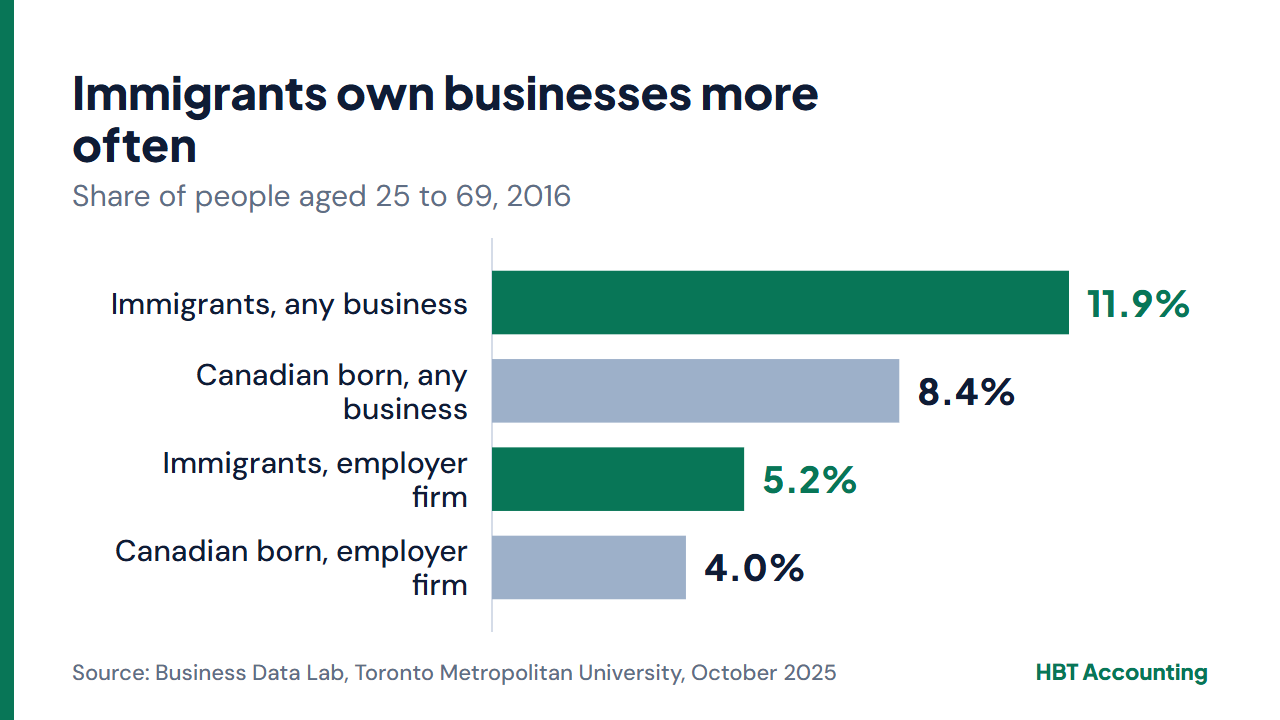
Statistics Canada reported in June 2025 that nearly one million private sector businesses were operating in Canada in the second quarter of that year, and 20.1% of them were majority owned by an immigrant. A Business Data Lab report from October 2025, written with Toronto Metropolitan University, used Statistics Canada microdata. It found that in 2016, 11.9% of immigrants aged 25 to 69 owned a business, against 8.4% of the Canadian born. Owning meant running an incorporated company with employees or being primarily self employed.
The same report found that incorporated immigrant owned businesses nearly doubled, from about 247,000 in 2010 to about 474,000 in 2020, and made up 57.3% of net new incorporated firms. Most are small, with 98% employing fewer than 10 people. Professional, scientific and technical services, transportation and warehousing, construction, retail trade and health care account for many of them, and Ontario is home to more than half. Women are roughly 27% to 29% of immigrant business owners.
BDC's May 2024 analysis defines an entrepreneur as a self employed person with paid help. On that narrower definition, 2.9% of immigrants aged 15 and over were entrepreneurs in 2023, against 2.0% of non immigrants, and immigrants made up 34% of all entrepreneurs, up from 27% in 2014. BDC reports that immigrant owned firms survive as often as Canadian born ones. Drawing on Statistics Canada's business conditions survey, it says 41.0% of immigrant led firms could take on more debt, against 59.8% of all private firms. It adds that 60.3% of immigrant owned businesses were optimistic about the next 12 months, against 68.4% of all private sector businesses.
The Canadian Federation of Independent Business published a February 2025 report, sponsored by Scotiabank and based on the experiences of 14 newcomer entrepreneurs. It says people who have been in Canada under 10 years own over 7% of enterprises. The challenges it lists are securing financing with a limited Canadian credit history, government regulations and compliance, building trust and networks, cultural and communication differences, and finding information. Fourteen interviews describe experiences, not rates. Each source also defines an owner differently, so the figures describe the same group from different angles and do not add up.
| Measure | Figure | Source and year |
|---|---|---|
| Private sector businesses majority owned by an immigrant | 20.1% | Statistics Canada, second quarter 2025 |
| Immigrants aged 25 to 69 who own a business | 11.9%, against 8.4% of the Canadian born | Business Data Lab, 2016 data |
| Immigrant owned incorporated businesses | About 474,000, from about 247,000 in 2010 | Business Data Lab, 2020 data |
| Entrepreneurs aged 15 and over, self employed with paid help | 2.9% of immigrants, 2.0% of non immigrants | BDC, 2023 data |
| Immigrants' share of all entrepreneurs | 34%, up from 27% in 2014 | BDC, 2023 data |
| Enterprises owned by people in Canada under 10 years | Over 7% | CFIB, February 2025 |
Key points
- Statistics Canada reported 20.1% of private sector businesses majority owned by an immigrant in the second quarter of 2025
- In 2016, 11.9% of immigrants aged 25 to 69 owned a business against 8.4% of the Canadian born
- A newcomer becomes a tax resident once residential ties begin, and the first return is due the year after
- Self employed filers have until June 15 to file but owe any balance by April 30, and GST/HST registration follows at $30,000
Residency and the first return
The CRA says residency for tax purposes starts once a person has enough residential ties with Canada, and for most newcomers that is the first day they live in Canada. Primary ties are a home, a spouse or common law partner and dependants in Canada. Secondary ties include a Canadian driver's licence, passport, bank accounts and provincial health insurance.
A newcomer is not required to file until the year after becoming a resident. Someone who became resident in 2025, in the CRA's example, files by April 30, 2026. Self employed individuals have until June 15 to file, and the CRA says any balance owing is still due by April 30. The CRA's newcomer page tells people to report income earned outside Canada for up to two years before becoming a resident. It adds that income earned before residency is not subject to Canadian tax.
Residency is a question of facts, and the CRA offers Form NR74 so that a person can ask for its opinion when entering Canada. Questions about another country of residence, a tax treaty or time spent abroad turn on the individual's own ties and dates, and they are outside this guide.
Business number and structure
A business does not always need a federal business number. The Canada.ca registration page says a business may need one along with related tax accounts. Registering with the provincial registry issues a number automatically in British Columbia, Manitoba, Nova Scotia, Ontario and Saskatchewan, and elsewhere a business that needs a number registers for it directly with the federal government. Some sole proprietorships that operate under the owner's own name do not need to register a business name, and Newfoundland and Labrador has no provincial registration for sole proprietorships or partnerships.
The structure choice is between an unincorporated business and a corporation. The Business Data Lab report describes sole proprietorships and partnerships as not legally distinct from their owners, often smaller and often early stage or driven by necessity. It describes incorporated businesses as registered legal entities subject to corporate tax. Which fits depends on income, liability, other income and plans for growth, and the related guide on sole proprietorships and corporations sets out the trade offs.
GST/HST, instalments and records
The CRA's guidance for self employed people says to register for GST/HST when taxable supplies pass $30,000 in a single calendar quarter or over the last four consecutive quarters. Registered businesses must file returns electronically. Commercial ride sharing is an exception. The small supplier threshold does not apply there, and registration is needed as soon as revenue starts.
For people required to pay by instalments, the due dates are March 15, June 15, September 15 and December 15. The CRA's June 2026 note lists June 15, September 15 and December 15 as the remaining dates in 2026. It tells self employed filers to keep all receipts, invoices and supporting documents for business income and expenses, and the newcomer page says supporting records are to be kept for at least six years.
As an illustration, a newcomer who becomes resident in March 2026 and starts consulting in June 2026 files the 2026 return in 2027. If self employed, the filing date is June 15, but any balance is still due April 30.
| Step | What the CRA says | Timing |
|---|---|---|
| Residency | Starts once residential ties are enough, for most newcomers on the first day in Canada | From arrival |
| First return | Filed for the year you become a resident, starting the year after | April 30, or June 15 if self employed |
| Balance owing | Still due when a self employed person files later | April 30 |
| GST/HST registration | Required when taxable supplies pass $30,000 in a quarter or over four quarters | Once the limit is passed |
| Instalments | Paid by people required to make them | March 15, June 15, September 15, December 15 |
| Records | Receipts, invoices and supporting documents, kept at least six years | Ongoing |
Immigration status
Tax residency and immigration status are separate questions. IRCC's December 2025 notice said it was no longer accepting applications for the Start Up Visa optional open work permit, apart from extensions. It said it would stop taking new Start Up Visa applications at the end of December 2025, with limited exceptions. It extended the pause on the Self Employed Persons Program until further notice and said a targeted pilot for immigrant entrepreneurs would be described in 2026. Whether a particular work permit allows self employment depends on the permit's own conditions, which IRCC confirms, so a person should check before starting.
Quick answers
When do I become a tax resident of Canada as a newcomer?
The CRA says residency starts once you have enough residential ties, and for most newcomers that is the first day you live in Canada. Your own ties and dates decide, and Form NR74 lets you ask the CRA for its opinion.
Do I need a business number to start a business in Canada?
Not always. A business may need a federal business number and tax accounts. Provincial registration issues one automatically in British Columbia, Manitoba, Nova Scotia, Ontario and Saskatchewan. Elsewhere you register for one directly with the federal government if you need it.
When do I have to register for GST/HST?
When taxable supplies pass $30,000 in a single calendar quarter or over the last four consecutive quarters, according to the CRA's guidance for self employed people. Commercial ride sharing drivers must register from the start.
When is my first tax return due after I arrive?
The return for the year you become a resident is due the following year, by April 30. Self employed filers have until June 15, but any balance owing is still due April 30.
Can I start a business on a work permit?
It depends on the conditions on the permit, and IRCC rather than the CRA decides. IRCC's December 2025 notice also paused the Self Employed Persons Program until further notice and closed the Start Up Visa optional open work permit to new applications.
Related pages
Official sources
- Statistics Canada: A Canadian data snapshot, through a multicultural lens
- BDC: Immigrant entrepreneurship is taking centre stage in Canada
- Business Data Lab: From Roots to Routes, Immigrant Entrepreneurs and How They Are Shaping Canada's Trade Future
- CFIB: Financing hurdles and government red tape among top challenges for Canada's newcomer entrepreneurs
- CRA: Newcomers to Canada and the CRA
- CRA: Self-employed? Make filing easier with these tips from the CRA
- Canada.ca: Registering a sole proprietorship or partnership
- IRCC: Update on Immigration Measures for Entrepreneurs
Call or email and we will tell you which records we need and what the work costs, in writing, before anything starts.
Important. This article provides general educational information, not legal or tax advice for a specific business. Rules, administrative policies, rates and deadlines can change. Confirm your facts and current obligations with the responsible government agency and a qualified adviser.