
Research briefs
How the CRA Chooses Returns to Review and Audit, and What the Tax Gap Shows
$34.7 billionis the CRA's upper bound estimate of the net federal tax gap for tax year 2022, or 9.3% of federal tax revenue, from its tax gap report published in March 2026.
By HBT AccountingSources checked 8 min read
Key points
- The CRA estimates the 2022 federal tax gap at $59.5 billion gross and $34.7 billion net of its own compliance work
- Returns are picked by computer risk screening, third party slip matching, claim types, compliance history and some random selection
- A review checks specific claims, an audit examines books and records, and an audit summary gives 30 days to reply
- Records are generally kept for six years from the end of the last tax year they relate to
What the tax gap measures
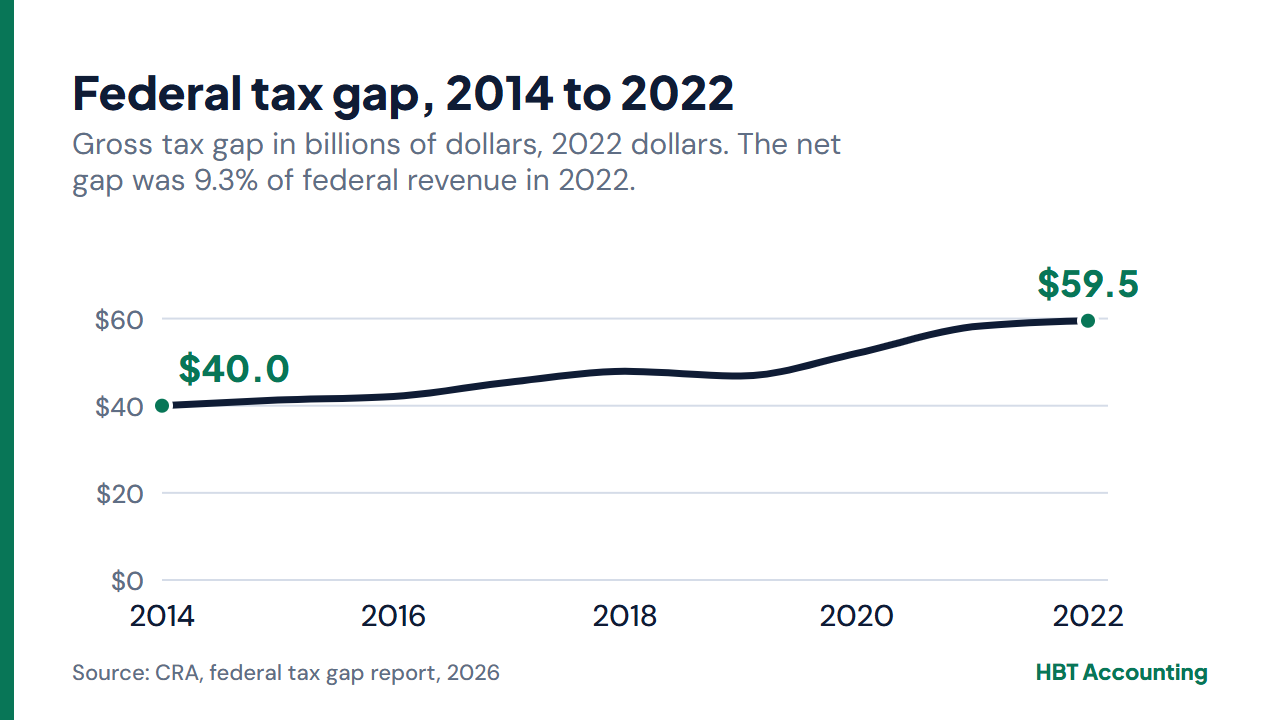
The CRA's second overall federal tax gap report, published in March 2026, covers tax years 2014 to 2022. For 2022 it estimates a gross federal tax gap of $59.5 billion, or 16.0% of federal tax revenue. After the results of the agency's own reviews, audits and collections, it projects a net gap of $34.7 billion, or 9.3%. These are upper bound figures in constant 2022 dollars, built on data as of January 2025. The lower bound puts the 2022 net gap at $28.2 billion.
The CRA is careful about what the figure means. The gap is the difference between the tax that would be paid if every obligation were met and the tax reported and collected, and it comes from both intentional and unintentional actions. The agency says it is unlikely ever to reach zero. Of the 2022 gross gap, 72% was a reporting gap, where returns were incomplete or inaccurate, and 28% was a payment gap, where assessed tax was not paid by the deadline.
The net gap has been steady. Across 2014 to 2022 it stayed between 8.5% and 9.5% of federal tax revenue on the upper bound, although the dollar amount rose from $23.8 billion to $34.7 billion as revenue grew. The CRA says it cut back some compliance work in 2020 and 2021 and concentrated on high risk, high dollar audit adjustments, so the net gap was higher for certain pandemic years. The table splits 2022 by tax.
| Tax | Gross gap | Gross gap as share of revenue | Net gap after CRA activity | Reduction from CRA activity |
|---|---|---|---|---|
| Personal income tax | $26.9 billion | 12.9% | $16.1 billion (7.7%) | 40.2% |
| Corporate income tax | $23.5 billion | 25.0% | $14.2 billion (15.1%) | 39.7% |
| GST/HST | $7.9 billion | 13.5% | $3.4 billion (5.8%) | 57.0% |
| Excise | $1.2 billion | 9.6% | $1.0 billion (8.3%) | 14% |
| All four | $59.5 billion | 16.0% | $34.7 billion (9.3%) | 41.7% |
How returns are picked
The CRA's pages give reasons rather than a scoring formula or thresholds. For individuals, its page on returns selected for review lists four: information that does not match third party slips such as T4s, the types of deductions or credits claimed, compliance history, and random selection. All returns are screened by computer, most are processed without a manual review, and the CRA says it refines the focus of its reviews each year based on results and areas of non compliance.
For businesses, the CRA says its risk assessment systems flag returns at high risk of non compliance, and an officer then reviews information from several sources before deciding whether an audit is needed. The tax gap report adds detail. It says the CRA targets audits at high risk areas, risk assesses all identified large corporations on a regular basis, and has used random audits of small and medium enterprises to understand compliance trends. The most recent random audit of that group covered tax year 2011. The T1 matching program compares an individual's return with information from employers and financial institutions. It reviewed about 2.97 million returns in the 2023 to 2024 program year, with a fiscal impact of $1.571 billion, a measure that includes tax assessed, refunds reduced, interest and penalties.
| Program | When it happens | What the CRA does |
|---|---|---|
| Pre assessment review | Before the notice of assessment | Like all the programs, checks that amounts are reported correctly and supported, and may ask for documents |
| Processing review | After the notice of assessment | Works much like the pre assessment review |
| Request verification | Before a notice of reassessment | Checks that a request to change a return is allowable and supported |
| Refund examination | Before or after a notice of assessment | Confirms that the proper refund is issued |
| Supplementary examination | Before or after a notice of assessment or reassessment | Looks more closely at income, loss and deduction amounts |
| Matching | After the notice of assessment | Compares the return with third party information such as employers and financial institutions |
Review versus audit
A review checks particular claims. The CRA says selection for review does not represent a tax audit. An audit is the examination of books and records to determine the tax, interest and penalties payable. When a review needs more information, the CRA contacts the taxpayer or an authorized representative by telephone or in writing. An audit usually begins with a call from the auditor, followed by a letter confirming the audit details.
An audit then runs in stages. The auditor normally asks for electronic records first, works at the place of business or borrows documents to finish at a CRA office or another location, and sends a written summary of findings. If changes are proposed, the business has 30 days to respond to that summary. The file closes with no change or with a reassessment, and a business that disagrees can speak to the auditor, then the team leader, and can file an objection.
| Point | Review | Audit |
|---|---|---|
| What is checked | Specific amounts, claims and credits on a return | The books and records behind the amounts filed |
| First contact | A call or a letter, and the letter carries a reference number | Usually a call, then a letter confirming the audit details |
| Records asked for | The documents the letter lists that apply to the situation | Ledgers, journals, invoices, receipts, contracts and bank statements, and sometimes the owner's personal records |
| How to send them | Scanned through a CRA account, or by mail to the address in the letter | Through CRA secure online services, by mail or at a tax services office, but not by email |
| Time to reply | The time frame stated in the letter | 30 days to respond to the written summary of findings |
Answering a review letter
The CRA's guidance is short. Reply within the time frame indicated, to the address in the letter, and include the reference number found in the upper right corner. Send the receipts or other documents the letter asks for that apply to the situation. If a document no longer exists, include a written explanation or call the number at the bottom of the letter. If a claim was changed after a review, new information can be submitted and the CRA will look at the claim again.
The CRA page gives no fixed number of days, so the deadline is whatever the letter says. It does not say what follows a missed date, and it names a call to the number on the letter as the way to ask for more time. The Pre assessment Review and Processing Review lines are open Monday to Friday, 8 am to 4 pm Eastern. The taxpayer or an authorized representative can also send scanned documents through a CRA account.
- Check that the contact is genuine before sharing details. For audits, the CRA says a person can end a call, verify the auditor's identity and call back.
- Keep a copy of everything sent, with the date and the method, and the reference number from the letter.
- Note the period and items the letter names, and ask the CRA to clarify anything that is unclear.
Records to keep
The CRA says records must generally be kept for six years from the end of the last tax year they relate to. For a corporation the tax year is the fiscal period, and for an individual it is the calendar year. If a return is filed late, the six years run from the date it is filed. Destroying records earlier needs the CRA's written permission, requested on Form T137 or by writing to a tax services office. Records must be kept at the place of business or residence in Canada unless the CRA gives written permission to keep them elsewhere.
What auditors ask for is broad. The CRA lists ledgers, journals, invoices, receipts, contracts and bank statements. In some audits it also asks for the owner's personal bank, mortgage and credit card statements, and for the records of related persons or entities such as a spouse, corporations, partnerships or trusts. For individual returns the CRA says it may want proof beyond official receipts, such as cancelled cheques or bank statements.
What owners report
The Canadian Federation of Independent Business published its seventh CRA Report Card in April 2023, using a survey of 4,304 business owners run in June and July 2022. In the previous three years, 51% said the CRA had contacted them by mail about something that required action. Only 4% said they had been contacted in person or virtually for an audit, down from 14% in 2017. The CFIB links the drop to the CRA pausing audits for several months in 2020 and 2021.
Owners who had been audited reported spending an average of 13.9 days complying with it, up from 11.5 days in 2017. The CFIB also notes that a letter or call about a routine matter leaves many owners fearing an audit, and it asks the CRA to say plainly what each contact requires.
Quick answers
Does the CRA choose returns for review at random?
In part. The CRA lists random selection as one reason a return may be reviewed, next to slip mismatches, the types of claims and compliance history. For businesses it says risk assessment systems flag high risk returns, and the tax gap report adds that it has used random audits of small and medium enterprises to study compliance trends.
What is the difference between a CRA review and an audit?
The CRA says selection for review is not an audit. A review checks specific amounts and claims, often through a call or letter asking for more information, while an audit examines books and records and ends with a written summary of findings.
How long do I have to reply to a CRA review letter?
The time frame stated in the letter. The CRA page gives no fixed number of days, and it says to call the number at the bottom of the letter if more time is needed.
How long should I keep tax records?
Generally six years from the end of the last tax year they relate to, or from the filing date if the return was filed late. The CRA's written permission is needed to destroy them sooner.
How big is the federal tax gap?
For tax year 2022 the CRA estimates a gross gap of $59.5 billion, or 16.0% of federal tax revenue, and a net gap of $34.7 billion, or 9.3%, after its compliance and collection results. Both are upper bound estimates.
Related pages
Official sources
- Canada Revenue Agency: Overall federal tax gap report: Estimates and key findings for non-compliance, tax years 2014-2022
- Canada Revenue Agency: How tax returns are selected for review
- Canada Revenue Agency: Types of reviews
- Canada Revenue Agency: Responding to us
- Canada Revenue Agency: Business audits
- Canada Revenue Agency: Review of your tax return by the CRA
- Canada Revenue Agency: Where to keep your records, for how long and how to request the permission to destroy them early
- Canadian Federation of Independent Business: 2023 CRA Report Card, Evaluating CRA's performance in its dealings with small businesses and tax practitioners
Call or email and we will tell you which records we need and what the work costs, in writing, before anything starts.
Important. This article provides general educational information, not legal or tax advice for a specific business. Rules, administrative policies, rates and deadlines can change. Confirm your facts and current obligations with the responsible government agency and a qualified adviser.