Research briefs
Commission Income Planning in Canada: GST/HST, Instalments and Setting Tax Aside
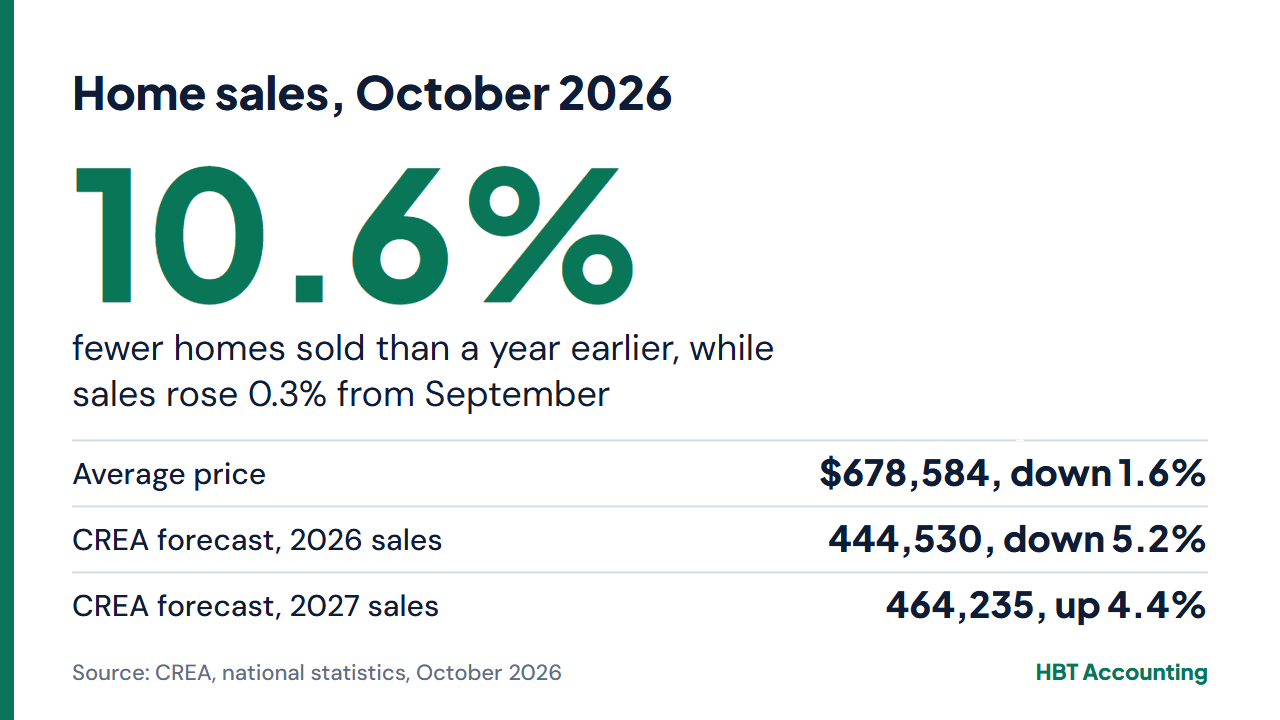
10.6%is how far actual national home sales in October 2026 sat below October 2025, according to the Canadian Real Estate Association's statistics released in November 2026.
By HBT AccountingSources checked 6 min read

Key points
- CREA reports October 2026 home sales 10.6% below a year earlier and forecasts a 4.4% rebound in 2027
- Self employed commissions count toward GST/HST registration once taxable sales pass $30,000 in a quarter or over four quarters
- Quarterly instalments apply once net tax owing passes $3,000 in the current year and in either of the previous two
- Self employed CPP for 2026 is up to $8,460.90, before second additional CPP on earnings above $74,600
Why activity swings
Commission income follows transactions, and transactions follow interest rates, confidence and the season. The Canadian Real Estate Association's statistics for October 2026, released in November 2026, show actual national home sales 10.6% below October 2025, even though sales rose 0.3% from September. The average sale price was $678,584, down 1.6% from a year earlier.
CREA's October 2026 forecast cuts expected 2026 sales to 444,530, a 5.2% decline from 2025. It cites higher fixed mortgage rates and uncertainty about how far variable rates may rise. It then expects a recovery to 464,235 sales in 2027, a gain of 4.4%.
A sales count is not a commission cheque, because price, split and closing date all matter. It does show why a tax plan built on last year's pace can miss in either direction, for realtors and for other commission earners alike.
| Measure | Figure |
|---|---|
| Home sales, October 2026, actual, against October 2025 | 10.6% lower |
| Home sales, October 2026, against September 2026 | 0.3% higher |
| National average price, October 2026 | $678,584, down 1.6% on a year earlier |
| Sales to new listings ratio, October 2026 | 48.7%, against a long term average of 54.7% |
| CREA forecast of 2026 sales | 444,530, down 5.2% from 2025 |
| CREA forecast of 2027 sales | 464,235, up 4.4% |
How commissions are taxed
A self employed commission salesperson reports commissions as part of business income on Form T2125. The CRA's guide T4002 lets self employed commission agents use the cash method or the accrual method, while other self employed people outside farming and fishing must use accrual. An employee who earns commission is a different case, and the guide says it does not cover that situation.
On Form T2125, gross commissions are entered including GST/HST collected or collectible, and the GST/HST is then taken out on a separate line so that it does not count as business income. Income records must show the date, amount and source of each item.
GST/HST on commissions
A commission is payment for a service, and registration turns on taxable revenue. The CRA's RC4022 guide says a small supplier does not have to register. The test is worldwide taxable revenue of $30,000 or less in any single calendar quarter and in the last four consecutive calendar quarters. Revenue of associates counts toward the total.
For real estate, the CRA's page on GST/HST in special cases covers agents. A registered agent has to charge and remit GST/HST on the commission and on other services to clients, other than financial services. Services tied to selling or renting real property are generally taxable even when the property itself is exempt from GST/HST. An agent whose commissions are taxable counts them toward the $30,000 test. Other commission work may be taxable or exempt, so the answer depends on what is sold.
These registration rules are federal and apply in every province and territory. The GST/HST rate does differ by province, and Quebec residents use a lower instalment threshold.
| Situation | What the CRA says |
|---|---|
| Taxable revenue of $30,000 or less in every quarter and over four quarters | Small supplier, registration not required |
| More than $30,000 in a single calendar quarter | Small supplier status ends at once. Charge GST/HST on the supply that crossed the limit and register within 29 days |
| More than $30,000 over four consecutive quarters | Small supplier status ends at the end of the month after that quarter. Register within 29 days of the first sale no longer made as a small supplier |
| Voluntary registration below $30,000 | Allowed. Input tax credits can be claimed, and the registrant must stay registered at least one year before cancelling |
Setting tax aside
Three amounts need to stay apart from each commission cheque: GST/HST collected, income tax and CPP. GST/HST collected is remitted to the CRA less input tax credits for GST/HST paid on business expenses. For income tax and CPP, one way to find a set aside rate is to divide the tax and CPP on the last assessed return by that year's net business income. The result can then be applied to each period's net income.
CPP is a large piece of that arithmetic for a self employed person. For 2026 the CRA sets maximum pensionable earnings at $74,600, a basic exemption of $3,500 and a maximum self employed contribution of $8,460.90, which is the employee and employer maximums of $4,230.45 added together. Second additional CPP contributions, which the CRA lists on a separate page, apply to earnings above the maximum pensionable earnings and come on top of that amount.
The table is an illustration with invented figures, not a forecast and not CRA guidance. It assumes an agent charging GST at 5% and a set aside rate of 27% of net business income, a rate chosen only for the example. The real rate depends on income, province and credits, and the agent's own notice of assessment is the better starting point.
| Quarter | Commissions before GST | GST collected at 5% | Expenses before GST | Net business income | Set aside at 27% |
|---|---|---|---|---|---|
| First | $20,000 | $1,000 | $6,000 | $14,000 | $3,780 |
| Second | $60,000 | $3,000 | $12,000 | $48,000 | $12,960 |
| Third | $40,000 | $2,000 | $9,000 | $31,000 | $8,370 |
| Fourth | $10,000 | $500 | $5,000 | $5,000 | $1,350 |
| Year | $130,000 | $6,500 | $32,000 | $98,000 | $26,460 |
Instalments
For most individuals the instalment dates are March 15, June 15, September 15 and December 15, and a date that falls on a weekend or public holiday moves to the next business day. The CRA requires instalments when net tax owing for the year is above $3,000, or $1,800 for Quebec residents. Net tax owing for either of the two previous years must also have been above that amount.
The CRA offers three ways to calculate them. The no calculation option has the CRA set the amounts from the latest assessed return and suits steady income. The prior year option works from last year's return, and the current year option works from an estimate of this year's figures and suits a year that will differ significantly from the last two. Paying in full by the due dates under either of the last two options avoids instalment interest and penalty, unless the estimated amounts are too low.
Commission income rarely repeats, so the choice matters. Because the no calculation amounts follow the last assessed return, they track the previous year and not the current one.
Expense records
The CRA requires records of every transaction that support income and expense claims, kept for a minimum of six years from the end of the last tax year they relate to. They are not sent with the return, but they are what the CRA asks to see. A registrant also needs the GST/HST paid on each expense to claim input tax credits.
- Meals, beverages and entertainment are limited to 50% of the lesser of the amount incurred and an amount reasonable in the circumstances.
- A vehicle used for both business and personal trips needs records showing the part of total kilometres driven for the business.
- Accounting fees for advice and for help with record keeping are deductible.
- Duplicate deposit slips, bank statements and cancelled cheques are kept, with separate records for each business.
Quick answers
Do real estate agents have to charge GST/HST?
Once taxable revenue passes $30,000 in a single calendar quarter or over four consecutive quarters, registering and charging GST/HST is required. Agents below that can register voluntarily and claim input tax credits.
Can a commission salesperson use the cash method?
Yes. The CRA's guide T4002 says self employed commission agents can use the cash method or the accrual method to report income. Other self employed people outside farming and fishing must use the accrual method.
Do I have to pay tax instalments on commission income?
Generally yes when net tax owing is above $3,000 ($1,800 in Quebec) in the current year and was above it in either of the two years before. Instalments are due March 15, June 15, September 15 and December 15.
How much of each commission should I set aside?
The CRA sets no percentage. One method is to divide the tax and CPP on the last assessed return by that year's net business income. The 27% in this guide is an illustration only.
What revenue counts toward the GST/HST threshold?
Worldwide taxable revenue, including the revenue of associates. The test is $30,000 in any single calendar quarter or over the last four consecutive calendar quarters.
Related pages
Official sources
- Canada Revenue Agency: General Information for GST/HST Registrants (RC4022)
- Canada Revenue Agency: T4002 Self-employed Business, Professional, Commission, Farming, and Fishing Income
- Canada Revenue Agency: Required tax instalments for individuals, Who has to pay
- Canada Revenue Agency: Required tax instalments for individuals, Options to calculate
- Canada Revenue Agency: CPP contribution rates, maximums and exemptions
- Canada Revenue Agency: GST/HST in special cases
- Canadian Real Estate Association: Canadian Home Sales and Prices Hold Steady in October, November 2026 news release
- Canadian Real Estate Association: CREA Revises Resale Housing Market Forecast
Call or email and we will tell you which records we need and what the work costs, in writing, before anything starts.
Important. This article provides general educational information, not legal or tax advice for a specific business. Rules, administrative policies, rates and deadlines can change. Confirm your facts and current obligations with the responsible government agency and a qualified adviser.