Research briefs
Crypto and Canadian Tax: Capital Gain or Income, Records and the Proposed Reporting Rules
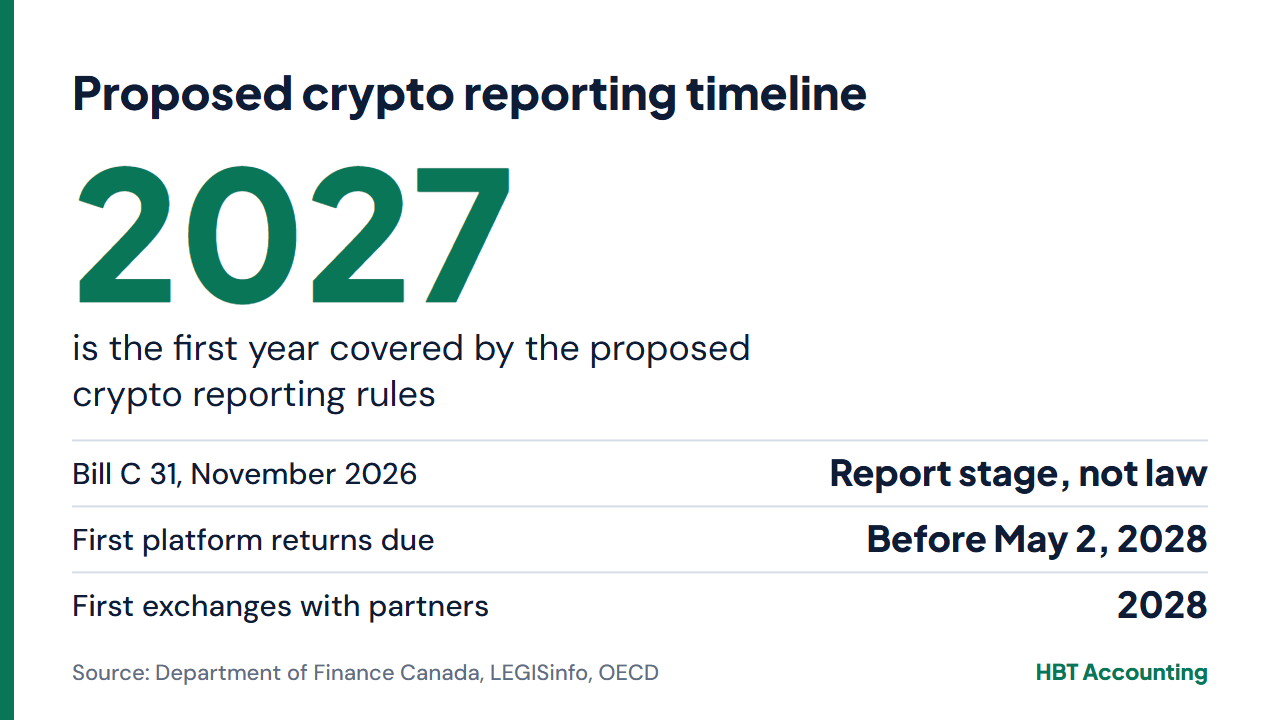
2027is the first calendar year for which Canadian crypto platforms would collect user information for the CRA under Bill C-31, which was still before the House of Commons in November 2026.
By HBT AccountingSources checked 6 min read

Capital gain or business income
The CRA's guide for cryptocurrency users says it generally treats cryptocurrency like a commodity under the Income Tax Act. Income from it is business income or a capital gain, depending on the circumstances, and losses follow the same label. Holding crypto is generally not taxable. A disposition is, and the guide counts selling, gifting, trading one crypto for another, converting to Canadian dollars and spending it on goods or services. Paying for something with crypto is treated as a barter transaction.
The guide lists business indicators: commercial activity, a businesslike approach, promotion and an intent to profit, judged case by case. A single transaction can be business income if it is an adventure or concern in the nature of trade. Only half of a capital gain is taxable, and capital losses offset only capital gains. The guide carries a June 2021 page date, so it predates the reporting rules below. These are federal rules and apply across Canada.
Mining is a hobby or a business depending on the facts, and the guide says a hobby run in a sufficiently commercial and businesslike way can be taxed as a business. For a taxable sale paid for in crypto, GST/HST is worked out on the fair market value of the crypto at the time of the exchange.
| Situation in the guide | CRA result |
|---|---|
| Frequent day trading, $240,000 sold against $200,000 of cost | $40,000 of business income |
| Bitcoin used to buy furniture, $500 gain | Capital gain |
| Capital gain of $5,600 | $2,800 taxable capital gain |
| Capital loss of $4,400 | $2,200 allowable capital loss, usable only against capital gains |
Key points
- The CRA treats crypto as a commodity, and income from it is a capital gain or business income
- Holding crypto is generally not taxable, while selling, trading, spending or gifting it is a disposition
- Bill C-31 would start platform reporting with 2027, returns due before May 2, 2028, and is still before the House
- The Bank of Canada survey paper found about 10% of Canadians owned bitcoin in 2023, with a median holding of $500
Records for a year of trades
The CRA's guide lists the records to keep, and says they must be kept for at least six years after the end of the last tax year they relate to. Where no direct value exists, a reasonable method applied consistently is expected, with a record of it. Miners add receipts for hardware, records of operating expenses and mining pool details.
Each type of crypto is valued separately. For capital property, the adjusted cost base has to be tracked so that gains are calculated accurately. The table is an illustration of a ledger with invented values for a made up coin. In a real ledger every row also carries the exchange or wallet address and the transaction identifier.
| Month | Event | Units of Coin A | Canadian dollar value | Fee | Taxable event |
|---|---|---|---|---|---|
| March | Bought on an exchange | Plus 1.00 | $30,000 | $60 | No |
| May | Bought on an exchange | Plus 0.50 | $17,000 | $40 | No |
| August | Sold for Canadian dollars | Minus 0.60 | $21,000 | $50 | Yes, a disposition |
| October | Spent on equipment | Minus 0.10 | $3,500 | $0 | Yes, treated as barter |
| November | Traded for Coin B | Minus 0.20 | $7,000 | $25 | Yes, a disposition |
| December | Gifted to a family member | Minus 0.05 | $1,800 | $0 | Yes, a disposition |
| Year end | Held | 0.55 |
- The date of each transaction and receipts of purchase or transfer.
- The Canadian dollar value at the time of the transaction.
- Digital wallet records, crypto addresses and exchange records.
- A description of the transaction and the other party.
- Accounting and legal costs, and software costs for managing tax affairs.
The proposed reporting rules
The Crypto Asset Reporting Framework, or CARF, is an OECD standard completed in June 2023. It makes reporting crypto asset service providers collect a self certification of tax residence from each user and report transactions to their tax authority, which exchanges them with partner countries. Reports cover exchanges between crypto and money, exchanges between cryptos, and transfers, totalled by type of asset.
Canada has not enacted it. Finance Canada released draft rules in August 2025, and the Spring Economic Update 2026 lists them with a deferred application date of January 1, 2027. Bill C-31, the Budget 2025 Implementation Act, No. 2, was introduced in May 2026 and carries the framework as a new Part XXI of the Income Tax Act. The Parliament of Canada page showed the bill at report stage in the House of Commons in November 2026, with a Senate pre study under way. The House committee reported the bill with amendments in October 2026, so details could still change.
Under the bill as introduced and Finance Canada's explanatory notes, Part XXI would apply to the 2027 and later calendar years. Providers would file a return before May 2 of each year for the year before, and would finish due diligence on existing users before 2028. A user who fails to provide a required tax identification number on request would face a $500 penalty for each failure. The OECD list updated in September 2026 places Canada among the 27 jurisdictions making first exchanges by 2028.
| When | What | Status |
|---|---|---|
| August 2025 | Draft legislation released by Finance Canada | Draft |
| May 2026 | Bill C-31 introduced with Part XXI | Proposed |
| October 2026 | House committee stage completed | Proposed |
| November 2026 | Report stage in the House under way | Proposed, not law |
| 2027 | First calendar year covered if the bill passes as written | Proposed |
| Before May 2, 2028 | First platform returns due for 2027 | Proposed |
| By 2028 | Canada's first exchanges with partners, on the OECD list | Commitment |
What the evidence shows
The Bank of Canada's survey paper, published in March 2025, reports that bitcoin ownership stayed at around 10% in 2023, concentrated among men, younger people and those with higher income and education. The median holding was Can$500, and most owners saw bitcoin mainly as an investment. The paper's subject is bitcoin ownership.
A University of Chicago working paper from August 2024 studied Norway for 2018 to 2021, matching exchange trading data to tax returns. Its authors are Tom Meling of Ohio State and Magne Mogstad and Arnstein Vestre of Chicago. They found that 88% of crypto holders did not declare them. They also found that 80% of investors on domestic exchanges that share identifiable data with the tax authority did not declare. Reminder letters sent to people who had declared crypto before and then stopped raised compliance by 25 percentage points.
The authors say their results suggest that exchange data alone will not solve non compliance. That finding is about Norway, not Canada.
Quick answers
Is holding crypto taxable in Canada?
Generally no. The CRA says possessing or holding crypto is generally not taxable. Tax arises on a disposition such as selling, trading, converting to Canadian dollars, spending or gifting it.
Is crypto income a capital gain or business income?
It depends on the circumstances. The CRA looks at commercial activity, a businesslike approach, promotion and intent to profit. Business profits are business income, and only half of a capital gain is taxable.
Is swapping one coin for another taxable?
Yes. The CRA lists trading one cryptocurrency for another as a disposition. The gain or loss is worked out in Canadian dollars at the time of the trade.
What records should I keep for crypto?
Dates, receipts, Canadian dollar values at the time, wallet records and addresses, a description of each transaction, exchange records and related costs. The CRA says to keep records for at least six years after the end of the last tax year they relate to.
When would Canadian crypto platforms start reporting to the CRA?
Under Bill C-31, the proposed Part XXI would apply to 2027 and later calendar years, with returns due before May 2 of the following year. The bill was not law as of November 2026.
Related pages
Official sources
- Canada Revenue Agency: Guide for cryptocurrency users and tax professionals
- Department of Finance Canada: Explanatory Notes Relating to the Income Tax Act and Other Legislation
- Department of Finance Canada: Tax measures: Supplementary information
- Parliament of Canada: C-31 (45-1), LEGISinfo
- OECD: Jurisdictions committed to implement the Crypto-Asset Reporting Framework (CARF)
- OECD: Delivering Tax Transparency to Crypto-Assets: A Step-by-Step Guide to Understanding and Implementing the Crypto-Asset Reporting Framework
- Bank of Canada: Canadian Bitcoin Ownership in 2023: Key Takeaways
- University of Chicago Becker Friedman Institute: Crypto Tax Evasion, Working Paper 2024-106
Call or email and we will tell you which records we need and what the work costs, in writing, before anything starts.
Important. This article provides general educational information, not legal or tax advice for a specific business. Rules, administrative policies, rates and deadlines can change. Confirm your facts and current obligations with the responsible government agency and a qualified adviser.