
Research briefs
Budget 2026 for Canadian Small Business Owners: What Is Proposed and What Is Unchanged
$15 millionis the proposed capital gains exemption for each qualifying individual and business under the Canada Growth Incentive, in the federal budget the Department of Finance tabled in November 2026.
By HBT AccountingSources checked 6 min read
Key points
- Budget 2026 proposes a capital gains exemption of up to $15 million for each qualifying individual and each business
- The small business rollover would allow three following years, instead of one, to reinvest after a sale, from January 1, 2027
- Canadian controlled private corporations would be exempt from Part VI.1 tax on preferred share dividends paid from Budget Day
- All of these are proposals, and the tax annex proposes no change to the small business deduction or the inclusion rate
What the budget proposes
The federal budget tabled in November 2026 proposes three measures that matter to owners of small private companies, and it confirms a fourth announced in September. A new capital gains exemption would shelter up to $15 million for each qualifying individual and business. A wider rollover would give owners more time to reinvest after selling shares. Canadian controlled private corporations would be exempt from Part VI.1 tax on dividends paid on taxable preferred shares.
None of this is law yet. The Department of Finance describes every item in its tax measures annex as proposed, and Parliament must pass legislation before any of it applies. The table lists the measures that reach owners most directly.
| Measure | Who it helps | Status |
|---|---|---|
| Capital gains exemption up to $15 million, Canada Growth Incentive | Individuals who hold newly issued shares of a qualifying Canadian controlled private corporation | Proposed. Shares issued on or after Budget Day and before 2037 |
| Larger rollover for investments in small businesses | Individuals who sell eligible small business shares and reinvest in another one | Proposed. Dispositions on or after January 1, 2027 |
| Exemption from Part VI.1 tax on preferred share dividends | Canadian controlled private corporations that pay taxable preferred share dividends | Proposed. Dividends paid on or after Budget Day |
| Dividend allowance raised from $500,000 to $1,500,000 | Other corporations that pay taxable preferred share dividends | Proposed. Taxation years ending after 2026 |
| Productivity Mega Deduction, immediate expensing | Businesses that buy depreciable property | Draft legislation released in September 2026. Property acquired on or after September 15, 2026 |
| Instalment threshold raised from $3,000 to $7,500 | Corporations and individuals outside Quebec | Proposed. Taxation years beginning on or after January 1, 2028 |
| Filing and payment date of May 15 for all individuals | All individuals, including the self employed and their spouses or partners | Proposed. 2027 and later taxation years |
| Foreign property reporting threshold raised from $100,000 to $200,000 | Taxpayers who file Form T1135 | Proposed. Years ending after 2026 |
The $15 million exemption
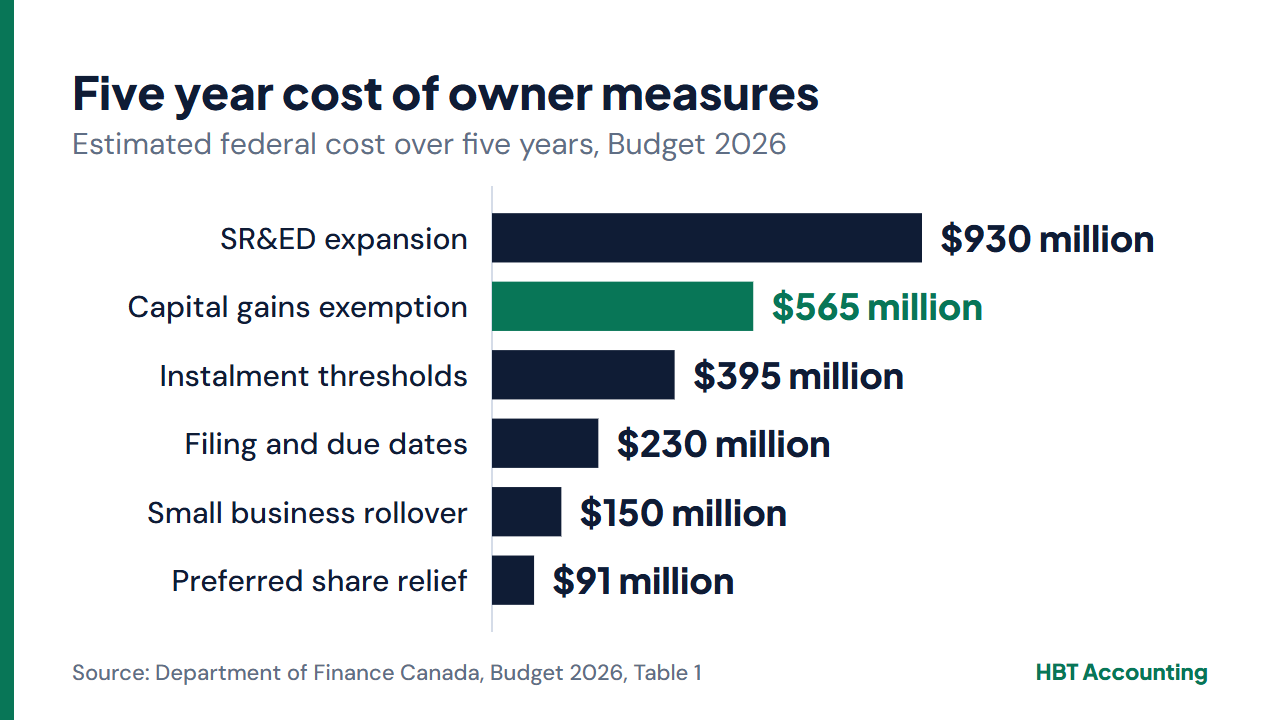
The Canada Growth Incentive has two parts, and the capital gains exemption is the larger. A qualifying individual must be at least 18 when the shares are acquired and a resident of Canada for the full year the exemption is claimed. The $15 million limit applies separately to each individual for each business. The annex puts the cost at $565 million over five years, all of it in the last two.
The shares must be newly issued. They must come from a Canadian controlled private corporation, be issued to the individual on or after Budget Day and before 2037, and be paid for in cash or earned through employment services. The corporation and its related corporations cannot hold more than $100 million in assets, by carrying value, immediately before and after the issue. The individual must then hold the shares for at least 36 consecutive months.
The business must be an active one, and the annex excludes a long list. Consulting, professional practices such as accounting, law, medicine, engineering and architecture, and businesses that rely mainly on employees' reputation or skill are out. So are agriculture, fishing, forestry, mining, finance, insurance, utilities, real estate, food and accommodation, arts, recreation and entertainment, and any business run under a licence or franchise agreement.
The budget gives an example for Ontario. A founder with a $15 million gain would keep nearly 96% of the value at exit, against about 71% before the budget. CFIB called the exemption promising if well designed. It said the rules leave out about half of the businesses that could otherwise use it, and that it will press for every sector the lifetime capital gains exemption covers.
A wider rollover
Today an individual who sells eligible small business shares can defer tax on the gain to the extent the proceeds buy replacement shares by the end of the following calendar year. The shares must have been held for at least 185 days. The budget would stretch the replacement period to the year of the sale plus the three following calendar years, with a reserve to defer the tax in the meantime.
Unreinvested proceeds would carry interest at a prescribed rate. An owner who signs a future equity agreement, such as a SAFE, before the three years end could defer the gain for two more years, five in total. During ownership the asset test would drop from all or substantially all active business assets to primarily active business assets. The stricter test would still apply when the shares are issued and when they are sold.
The changes would apply to qualifying dispositions on or after January 1, 2027. The annex puts the cost at $150 million over five years, and CFIB called the enhanced rollover a good measure for small business investment.
Preferred shares, expensing and smaller changes
Part VI.1 tax is a special tax on dividends paid on taxable preferred shares, which can be credited against regular tax. Canadian controlled private corporations would be exempt from it for dividends paid on or after Budget Day. For other corporations the dividend allowance would rise from $500,000 to $1,500,000, and the threshold that reduces it from $1,000,000 to $3,000,000, for taxation years ending after 2026. Finance is reviewing the wider regime and asked for written views by January 8, 2027.
The Productivity Mega Deduction, announced in September 2026, would let businesses deduct the full cost of most depreciable property acquired on or after September 15, 2026. Finance estimates it at $36 billion over five years and says it lowers the marginal effective tax rate on new investment from 13% to 6.4%. The budget confirms the government intends to proceed with the draft legislation. Smaller measures that owners may notice are below.
- Instalments would not be required until net tax owing passes $7,500, up from $3,000, for taxation years beginning on or after January 1, 2028. The threshold in Quebec would be $4,500 for individuals.
- From 2028, individuals whose main income is from a business could pay one instalment of two thirds of net tax owing, due December 31, instead of four.
- From the 2027 tax year, the filing and balance due date would be May 15 for all individuals. Today the self employed file by June 15 but pay by April 30.
- The foreign property reporting threshold on Form T1135 would double to $200,000, and the simplified reporting limit would rise from $250,000 to $500,000.
- The CRA could report tax debts over $50,000 to credit bureaus, after 30 days written notice and once objection rights have ended.
What the annex leaves alone
The annex proposes no change to the small business deduction, to the general capital gains inclusion rate or to the lifetime capital gains exemption, which stands at $1,275,000 for 2026. The only inclusion rate it mentions is 30% for alternative minimum tax purposes on gains exempted under the new incentive, the same treatment as gains eligible for the lifetime exemption.
CFIB, which counts 103,000 members, said the budget offered no tax reductions or tariff relief for small business. It said "small businesses appear to remain in the government's blind spot", while welcoming the expanded expensing and the rollover.
| Measure | Five year cost |
|---|---|
| SR&ED program expansion | $930 million |
| Capital gains exemption, Canada Growth Incentive | $565 million |
| Instalment thresholds and annual instalment | $395 million |
| Filing and balance due dates | $230 million |
| Small business rollover, Canada Growth Incentive | $150 million |
| Taxable preferred shares | $91 million |
Quick answers
Is the $15 million capital gains exemption in Budget 2026 law?
No. It is proposed in the tax measures annex and would apply to qualifying shares issued on or after Budget Day and before 2037, if Parliament passes the legislation.
Does Budget 2026 lower the small business tax rate?
The tax measures annex proposes no change to the small business deduction. CFIB said the budget gave small businesses no tax reductions.
What is the Canada Growth Incentive?
It is two proposed measures, a capital gains exemption of up to $15 million and a larger small business rollover. Finance estimates $715 million in tax relief over four years, starting in 2027 to 2028.
Would a professional corporation qualify for the new exemption?
Not as proposed. The annex excludes professional practices such as accountants, lawyers, physicians, engineers and architects from the qualifying business definition.
When would the May 15 filing date start?
With the 2027 tax year, if the proposal becomes law. The filing and balance due date would be May 15 for all individuals, including the self employed.
Related pages
Official sources
- Department of Finance Canada: Tax measures: Supplementary information, Budget 2026
- Department of Finance Canada: Chapter 1, Canada's Investment Supercycle, Budget 2026
- Department of Finance Canada: Government of Canada releases Budget 2026: Masters of our destiny
- Department of Finance Canada: Government of Canada introduces new Productivity Mega Deduction to boost Canada's advantage as the most competitive G7 country for new business investment
- CFIB: 2026 federal budget is mega disappointing for Canadian small businesses
- CRA: Indexation adjustment for personal income tax and benefit amounts
Call or email and we will tell you which records we need and what the work costs, in writing, before anything starts.
Important. This article provides general educational information, not legal or tax advice for a specific business. Rules, administrative policies, rates and deadlines can change. Confirm your facts and current obligations with the responsible government agency and a qualified adviser.