Research briefs
Selling Company Shares in Canada: How the Lifetime Capital Gains Exemption Works in 2026
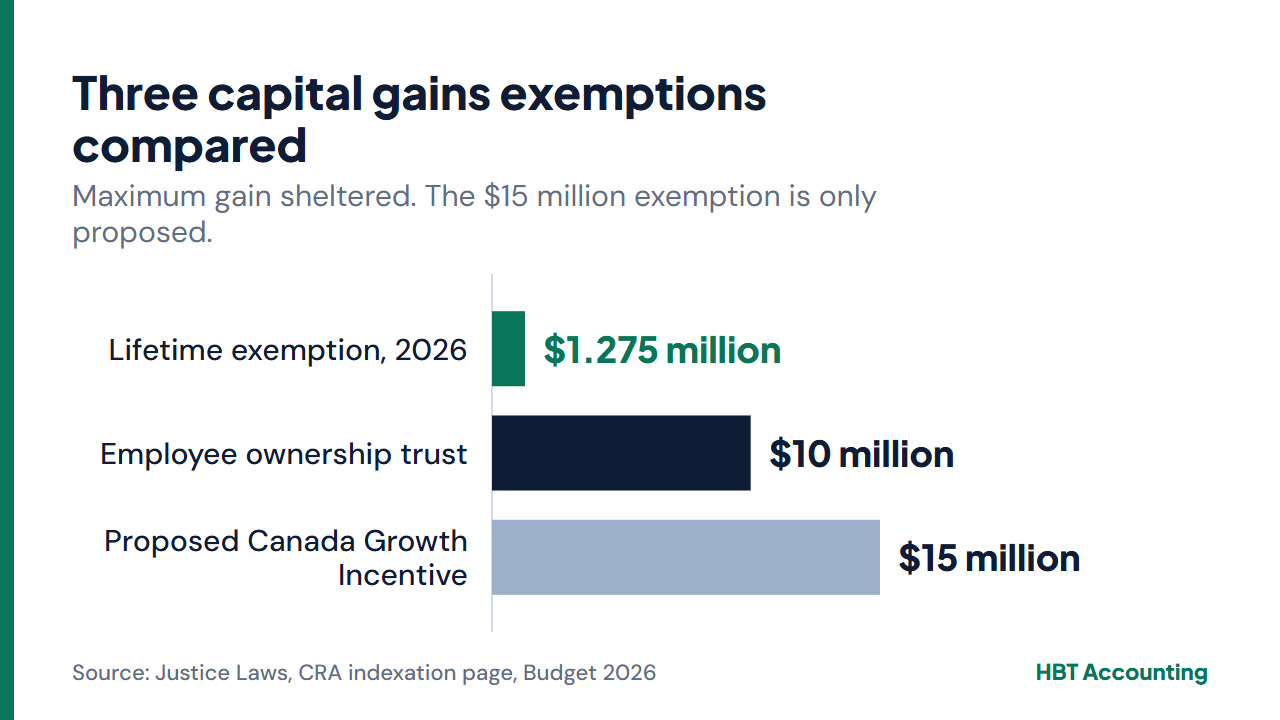
$1,275,000is the lifetime capital gains exemption limit for 2026 on qualified small business corporation shares, up 2.0% from $1,250,000, as the CRA reported in March 2026.
By HBT AccountingSources checked 6 min read
What the exemption covers
An individual who sells shares of a qualified small business corporation can claim a capital gains deduction, usually called the lifetime capital gains exemption. The CRA's indexation page gives the limit as $1,275,000 for 2026 and $1,250,000 for 2025. The same limit covers qualified farm and fishing property. The CRA guide on capital gains says the limit is indexed to inflation, and the 2026 adjustment was 2.0%.
The Budget 2025 Implementation Act, No. 1, which received royal assent in March 2026, raised the limit to $1,250,000 for dispositions on or after June 25, 2024 and let indexation resume in 2026. Subsection 110.6(2) of the Income Tax Act now caps the deduction using $625,000, which is one half of $1,250,000, before indexing. A transition rule in subsection 110.6(2.2) allows a further deduction of up to $116,582 for dispositions on or after June 25, 2024, in a year that includes that date.
The claimant must be a resident of Canada throughout the year. The deduction is calculated on Form T657 and claimed on line 25400 of the return. A sale of qualified small business shares is reported in Part 3 of Schedule 3, with the proceeds on line 10699 and the gain on line 10700, for the 2025 tax year.
Ownership can sit with the seller, the seller's spouse or common law partner, or a partnership the seller belongs to. The CRA guide also describes special rules for shares issued after June 13, 1988 to the seller or a related person, which can affect the holding period.
Key points
- The 2026 limit is $1,275,000 of capital gain, indexed by 2.0% from $1,250,000 in 2025
- Shares must pass a 24 month holding test, a 50% asset test and a 90% asset test at sale
- A share that fails any test does not qualify, and the whole gain is an ordinary capital gain, one half taxable
- Budget 2026 proposes a separate $15 million exemption that would limit the lifetime exemption on the same company
The three tests
A share qualifies only if it meets all three conditions in the table. The first two look back over 24 months. The third is checked on the day of the sale. The CRA treats the 90% figure as the meaning of all or substantially all of a corporation's asset value.
| Test | When it is measured | What it requires |
|---|---|---|
| Holding period | The 24 months before the sale | No one other than the seller, a partnership the seller belongs to or a related person owned the share |
| 50% asset test | While the seller or a related person owned the share in those 24 months | A share of a Canadian controlled private corporation with more than 50% of asset value in active business assets used mainly in Canada, or in shares or debts of connected corporations |
| 90% asset test | At the time of the sale | A small business corporation, a Canadian controlled private corporation with at least 90% of asset value in the same kinds of assets |
When a test fails
A share that misses any test is not a qualified small business corporation share. The deduction is not available on it, and the gain is reported as an ordinary capital gain. The CRA guide states that one half of a capital gain is taxable. Such a share goes on line 4 of Schedule 3 instead of line 1.
The 90% test is measured on the closing date. Assets that are neither active business assets nor shares or debts of connected small business corporations count against the 90% figure. Whether a company can be brought back within the tests before a sale depends on its facts and on anti avoidance rules, so it is a question for advice.
Two other items can shrink the claim. The CRA guide says investment income and expense records are needed to calculate the cumulative net investment loss on Form T936, which is a component of the deduction. Any allowable business investment loss claimed for 2025 also reduces the deduction available in 2025 and later years.
Budget 2026 adds one more point. It notes that gains eligible for the lifetime exemption have a 30% inclusion rate for alternative minimum tax purposes, so part of an exempt gain can still enter the minimum tax calculation.
When the sale produces a loss
A loss on small business shares follows its own path. The CRA guide treats a loss on shares of a small business corporation, or on a debt it owes, as a business investment loss when the other party deals at arm's length. A corporation counts as small if it was small at any time in the 12 months before the disposition.
For 2025 the gross loss is reported on line 21699 and the allowable portion is deducted on line 21700. Any excess over other income becomes a non capital loss. An allowable business investment loss not used within 10 tax years becomes a net capital loss in the eleventh year. Because the loss reduces later exemption claims, owners who might have both a loss and a gain should look at the two together.
An illustration with round numbers
The table is an illustration only. It assumes an individual who has used none of the exemption, shares that pass every test, and no investment losses. It ignores selling costs, alternative minimum tax and the provincial tax that applies to the taxable portion. The rate of tax on the result depends on the seller's other income.
| Step | Tests met | Tests failed |
|---|---|---|
| Sale price of the shares | $2,000,000 | $2,000,000 |
| Adjusted cost base | $100,000 | $100,000 |
| Capital gain | $1,900,000 | $1,900,000 |
| Exemption used | $1,275,000 | $0 |
| Gain left after the exemption | $625,000 | $1,900,000 |
| Taxable capital gain at one half | $312,500 | $950,000 |
What Budget 2026 proposes for entrepreneurs
The federal budget tabled in November 2026 proposes a second exemption, the Canada Growth Incentive capital gains exemption, for gains of up to $15 million. It is proposed, not law. It targets newly issued shares, so it is a different tool from the lifetime exemption, which works on shares that have been held for 24 months.
The two exemptions are linked. Claiming the new one on a corporation's shares would limit the lifetime exemption on shares of the same corporation, and the reverse. A sale to an employee ownership trust or a worker cooperative could generally use both. CFIB has asked for changes of its own in its October 2026 report. It wants asset sales covered, which the exemption now allows only for farm and fishing property, and a 33% inclusion rate on the next $2 million of gains beyond the lifetime exemption. Those are requests, not government proposals.
| Feature | Lifetime exemption, in force | Growth Incentive exemption, proposed |
|---|---|---|
| Limit | $1,275,000 of gain for 2026 | $15 million for each individual and each business |
| Shares | Shares held for 24 months before the sale | Shares issued on or after Budget Day and before 2037, for cash or services |
| Holding period | 24 months | 36 consecutive months |
| Company size | No dollar cap on assets | Assets of $100 million or less, with related corporations |
| Business | 90% of assets in active business at sale | Active business, with a list of excluded sectors and professional practices |
Quick answers
How much is the lifetime capital gains exemption in 2026?
$1,275,000 of capital gain, according to the CRA. It was $1,250,000 for 2025, and the 2026 figure reflects 2.0% indexation.
What are the tests for qualified small business corporation shares?
A 24 month holding period, a 50% active asset test over those 24 months, and a 90% active asset test at the time of the sale. The company must also be a Canadian controlled private corporation.
What happens if my company fails the 90% test on the day of the sale?
The shares do not qualify, so no exemption applies. The gain is reported as an ordinary capital gain, and one half of it is taxable.
Can I use the exemption when I sell the assets of my company instead of shares?
Not for a small business corporation. The exemption covers shares of a qualified small business corporation and qualified farm or fishing property. CFIB has recommended extending it to asset sales.
Is the $15 million exemption available now?
No. Budget 2026 proposes it for shares issued on or after Budget Day. It needs legislation before it applies.
Related pages
Official sources
- CRA: Indexation adjustment for personal income tax and benefit amounts
- CRA: Capital Gains - 2025
- Justice Laws: Income Tax Act, section 110.6
- Justice Laws: Budget 2025 Implementation Act, No. 1, S.C. 2026, c. 3
- Department of Finance Canada: Tax measures: Supplementary information, Budget 2026
- CFIB: Passing the Torch: How Canada's Small Business Owners Are Planning Their Exit and Why the Next Generation of Ownership Matters
Call or email and we will tell you which records we need and what the work costs, in writing, before anything starts.
Important. This article provides general educational information, not legal or tax advice for a specific business. Rules, administrative policies, rates and deadlines can change. Confirm your facts and current obligations with the responsible government agency and a qualified adviser.