
Research briefs
The Succession Planning Gap in Canada: 63% Plan to Exit and 6% Have a Written Plan
6%of Canadian small business owners have a formal written succession plan, while 63% expect to exit within 10 years, CFIB reported in October 2026 from a survey of 1,731 owners.
By HBT AccountingSources checked 6 min read
What CFIB measured
The Canadian Federation of Independent Business published Passing the Torch in October 2026. It draws on an online survey of 1,731 small business owners, carried out between May and June 2026, weighted by industry and age of owner. The margin of error is plus or minus 2.35%, 19 times out of 20. CFIB notes that owners with a stronger interest in succession may have been more likely to respond.
Of the owners surveyed, 63% plan to leave within 10 years. That is 8% within 12 months, 35% within 1 to 5 years and 20% within 6 to 10 years. Retirement is the reason for 78%, burnout or stress for 21% and high operating costs for 20%. On how they will leave, 54% plan to sell to an unrelated buyer, 28% to employees, 21% to family and 19% to transfer to family without a sale. Another 13% expect to close.
Key points
- CFIB found 63% of owners expect to exit within 10 years, which it values at more than $2 trillion in assets
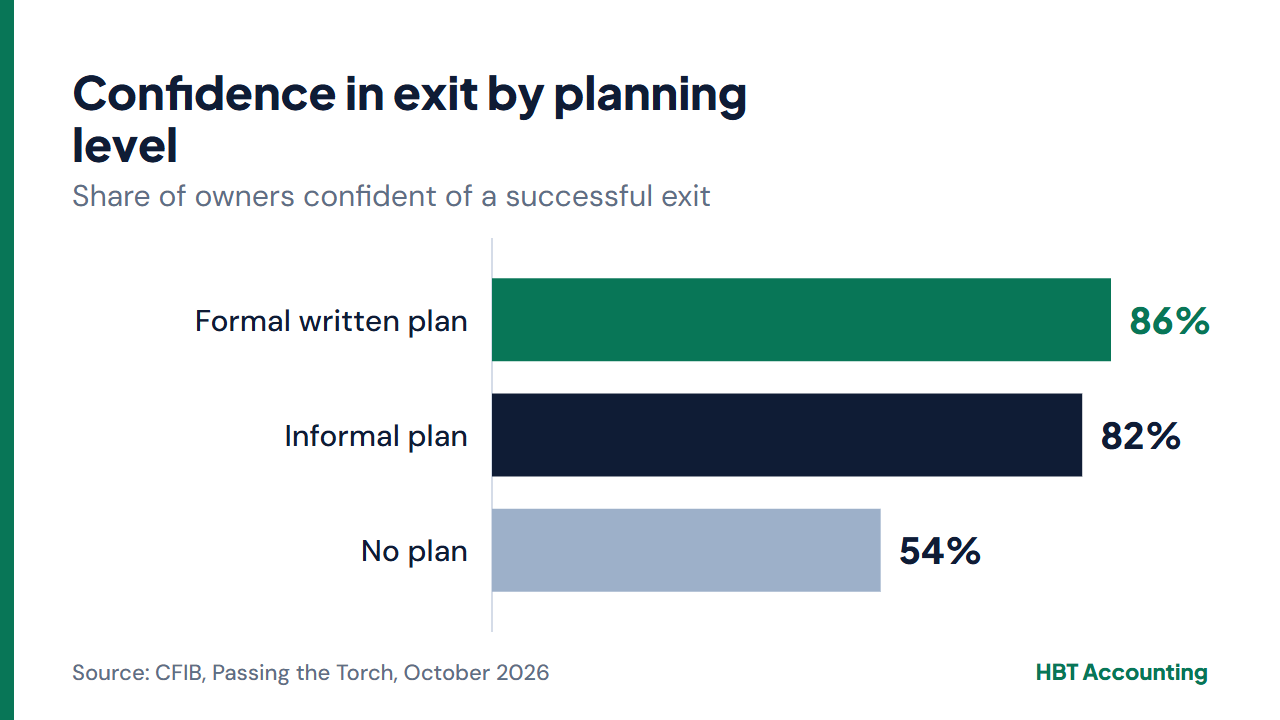
- Only 6% have a formal written plan, and owners with one are more confident of a good exit, 86% against 54%
- Finding a buyer is the top barrier at 47%, ahead of valuation and lack of time at 37% each
- Statistics Canada found 20.3% of businesses intend to sell or transfer within 10 years, a different group and question
Few plans and more confidence with one
CFIB defines a formal plan as a documented plan that names a successor and sets a process and timeline. An informal plan has been discussed but lacks a timeline or legal documents. Half of owners have no plan at all, and the share with a formal plan rises only to 23% among those leaving within 12 months.
Confidence follows planning. Among owners with a formal plan, 86% are confident of a successful exit, and 48% are very confident. Among owners with no plan, 54% are confident and 13% are very confident. Of the owners who acquired an existing business, 81% of those with a formal plan called the transition smooth, against 69% of all such owners.
| Planning status | Share of owners | Confident of a successful exit | Very confident |
|---|---|---|---|
| Formal written plan | 6% | 86% | 48% |
| Informal plan | 44% | 82% | 28% |
| No plan | 50% | 54% | 13% |
Where the $2 trillion comes from
CFIB says more than $2 trillion in business assets could change hands, and its appendix shows the method. It applies the share of owners planning to exit, which rounds to 63%, to about $3.281 trillion, the total assets of incorporated small and medium businesses with revenues up to $25 million. The asset total comes from a Statistics Canada tabulation, and CFIB puts the result at $2.053 trillion.
The figure applies an owner share to an asset total, so it is a ballpark, as CFIB itself says, and not an appraisal of any sale. BDC measures a different base. Its January 2026 study put more than $300 billion in revenues at stake over five years.
What other research finds
BDC's January 2026 study cites Statistics Canada for the finding that nearly 61% of small and medium businesses are led by owners aged 50 or older. Its own Business Transition Survey of September 2025, with 2,001 respondents, found that almost one in five businesses are very likely to exit within five years. Experienced acquirers expect a transition to take over a year longer than sellers expect. Only 5% of first time buyers had taken a preparatory step, against 19% of experienced buyers.
A BDC article in August 2026 adds that 24% of owners likely to exit within five years have a formal succession plan or exit strategy. It says a full transition often takes three to five years. Statistics Canada's Canadian Survey on Business Conditions for the third quarter of 2026 found that 20.3% of businesses intend to sell or transfer within 10 years. Another 42.6% do not, and the plans of 37.1% were unknown.
The numbers differ because the questions and groups differ. CFIB asked owners when they intend to sell, transfer or close, and Statistics Canada reported whether a business intends to sell or transfer. Two authors at the University of Ottawa's Telfer School argued in December 2025 that succession is a human and strategic challenge, not only a matter of tax incentives. They also called for better national data on family firms. That is commentary, not a survey result.
| Survey | Group asked | Plans to leave or sell | Formal plan |
|---|---|---|---|
| CFIB, 2026 | 1,731 small business owners | 63% within 10 years | 6% formal written plan |
| Statistics Canada, third quarter 2026 | Businesses in Canada | 20.3% intend to sell or transfer within 10 years, 37.1% unknown | Not reported |
| BDC, September 2025 | 2,001 businesses | Almost one in five very likely to exit within five years | 24% of likely exiters have a plan or exit strategy |
What a buyer or successor will ask for
BDC's due diligence guidance lists what a serious buyer requests. The financial package usually covers accountant prepared year end statements for at least the past three to five years. It adds interim statements, trial balances, forecasts, bank statements, revenue by customer, inventory aging, and receivable and payable aging. Tax returns should match the financial statements.
Legal and operating records follow. Buyers ask for corporate documents such as bylaws and shareholder agreements, licences and permits, leases, customer and supplier agreements, employment contracts, litigation history, asset records and employee turnover. They also check whether key contracts can be assigned to the buyer. A third party quality of earnings report may be commissioned to test how sustainable the profits are.
- Decide the exit path, whether an outside sale, a transfer to employees or family, or a gradual handover.
- Value the business before looking for a buyer, because BDC places the valuation ahead of the search.
- Clean up the books and keep them current, and document how the business runs without the owner.
- Review shareholder agreements, buy sell provisions and insurance, and write the plan with a timeline.
- Revisit the plan regularly, as CFIB recommends, because values and circumstances change.
Where a valuation fits
Valuation is the barrier where a number helps most. Among the 37% of owners who called valuation a challenge, 66% did not know what the business is worth, 50% did not know where to start and 43% cited the cost. BDC describes three report levels, a calculation, an estimate and a comprehensive report, and three methods based on earnings, market multiples or assets.
BDC also notes that fair market value is not necessarily the selling price, since market conditions, financing and the owner's role after the sale all affect it. If the value is below what the owner expects, BDC suggests improving the business before selling. What a valuation depends on in a given case is a question for the advisor preparing it.
Quick answers
How many Canadian business owners plan to exit within 10 years?
CFIB found 63% of small business owners in its 2026 survey. Statistics Canada found 20.3% of businesses intend to sell or transfer within 10 years, using a different group and question.
What share of small business owners have a succession plan?
In CFIB's 2026 survey, 6% have a formal written plan, 44% have an informal plan and 50% have no plan.
What documents will a buyer ask for?
Typically three to five years of year end financial statements, interim statements, tax returns that match them, corporate records, contracts, leases, licences, asset records and employee information.
How long does a business transition take?
BDC says owners expect about two years on average and a full transition often takes three to five years.
When should an owner get a business valuation?
Before looking for a buyer. BDC's steps for selling place the valuation ahead of the search, and it advises planning well in advance because many owners underestimate preparation time.
Related pages
Official sources
- CFIB: Passing the Torch: How Canada's Small Business Owners Are Planning Their Exit and Why the Next Generation of Ownership Matters
- BDC: The M&A Advantage for Canada's Entrepreneurs, January 2026
- BDC: Many entrepreneurs are ready to pass the torch, but few are prepared
- BDC: How to conduct due diligence when buying a business
- BDC: How to sell your business
- Statistics Canada: One in five Canadian businesses intends to sell or transfer, how many will change hands
- University of Ottawa, Telfer School of Management: Budget 2025 ignores the looming succession crisis facing Canada's family businesses
Call or email and we will tell you which records we need and what the work costs, in writing, before anything starts.
Important. This article provides general educational information, not legal or tax advice for a specific business. Rules, administrative policies, rates and deadlines can change. Confirm your facts and current obligations with the responsible government agency and a qualified adviser.