Research briefs
Late Payments in Canada: How Long Small Businesses Wait to Be Paid
10.5 daysis how late Canadian small businesses were paid on average in the September 2026 quarter, Xero reported in October 2026, using data from 12,000 small businesses.
By HBT AccountingSources checked 6 min read

How late customers pay
Canadian small businesses were paid an average of 10.5 days late in the September 2026 quarter, according to Xero's Small Business Insights report from October 2026. The June quarter figure was 10.8 days. Xero builds the series from anonymized data on 12,000 Canadian small businesses that use its software, and it said Canada continues to have the longest late payment times of the countries it tracks.
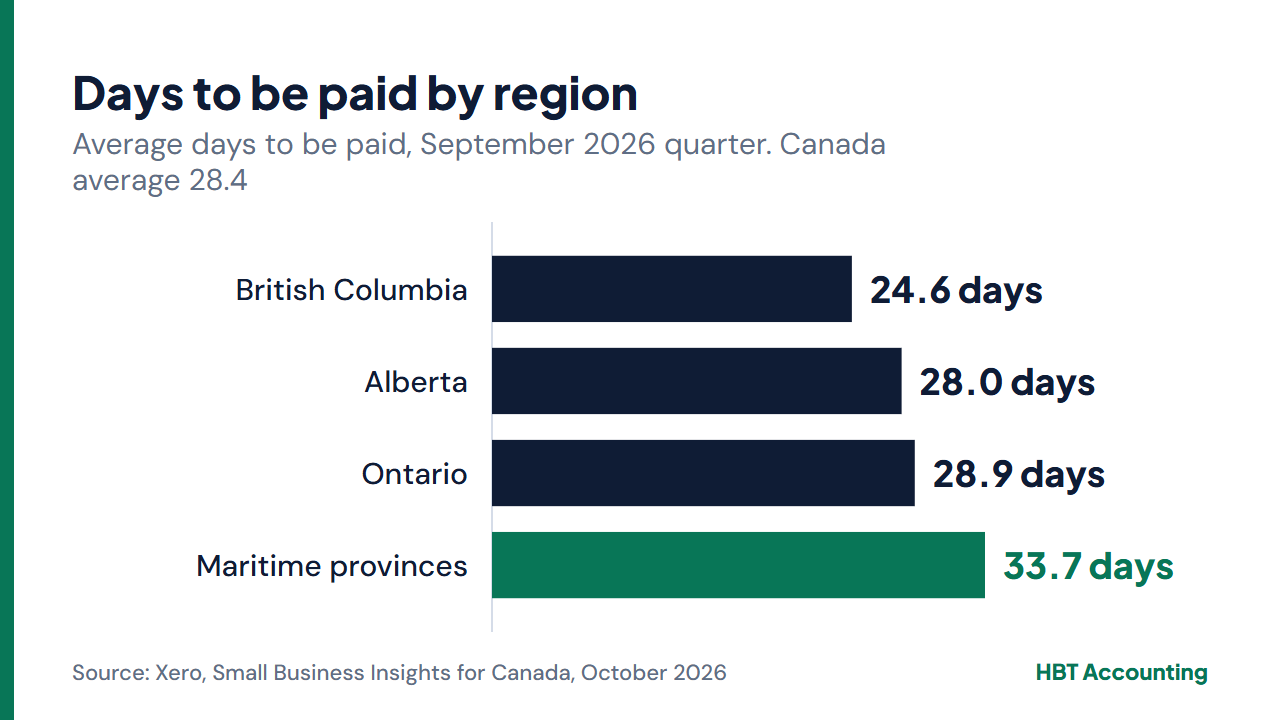
A second Xero measure, the average time to be paid, was 28.4 days in the September quarter and 28.2 days in the June quarter. Regions differed by about nine days between the quickest and the slowest.
| Region | Days to be paid | Sales growth from a year earlier |
|---|---|---|
| British Columbia | 24.6 | Down 2.6% |
| Alberta | 28.0 | Up 5.9% |
| Ontario | 28.9 | Up 2.2% |
| Maritime provinces | 33.7 | Down 1.4% |
| Canada | 28.4 | Up 2.0% |
Key points
- Xero found Canadian small businesses were paid 10.5 days late in the September 2026 quarter, against 10.8 days in June
- Equifax reported supplier delinquency fell 24.4% to 4.26% in the second quarter of 2026, while delinquency on lender credit hit 4.0%
- A GST/HST bad debt adjustment must be claimed within four years of the return due date for the write off period
- Interest quoted monthly on an overdue invoice is capped at 5% a year unless the contract states the yearly rate
Where the pressure shows in credit data
Credit bureau data shows lateness moving in different directions depending on who is owed. Equifax Canada reported in September 2026 that delinquency on supplier accounts, which it tracks as industrial trade, fell 24.4% from a year earlier to 4.26% in the second quarter of 2026. The measure counts accounts 60 days or more past due.
Over the same quarter, the delinquency rate on credit products from lenders, measured at 60 days or more past due, reached 4.0%. That was up 19.7% from a year earlier and the highest since 2019. The number of businesses with at least one account 30 days past due fell 3.6% from a year earlier to 271,645, but Equifax said late payments on financial products became more severe.
BDC's Canadian Small Business Health Index, built with Equifax credit data, showed a similar split in its May 2026 edition covering the first quarter. Supplier credit 30 days or more past due improved, while lender credit 90 days or more past due rose. BDC read that as a sign that some small businesses face deeper financial difficulty.
Trade credit also links firms to each other. A 2017 Bank of Canada staff working paper by Lin Shao modelled firms that supply inputs to one another on credit. It found that when financial markets are in distress, suppliers cut back trade credit, which tightens the borrowing limits of their customers. The paper estimated that the drop in trade credit during the Great Recession accounts for roughly a quarter of the fall in output.
Terms, interest and follow up
Late payment is easiest to manage when the contract or invoice settles it in advance. A due date, accepted payment methods and the consequence of paying late should be written down and agreed before delivery. On larger jobs a deposit, or billing at milestones, moves cash forward and limits what any one customer can owe at a time.
Interest on overdue invoices is a matter of contract, and the federal Interest Act sets one limit. Section 4 covers written contracts that state interest at a rate for a period shorter than a year, such as a month. In that case no more than 5% a year can be recovered unless the contract also states the equivalent yearly rate. A clause for 2% a month should therefore carry its yearly equivalent. Whether a given clause is enforceable depends on the contract and on provincial law.
A common sequence for an overdue invoice escalates in steps.
- A short reminder within days of the due date, written as if the delay were an oversight.
- A phone call and a written note within about two weeks that restate the amount, the due date and a requested payment date.
- A formal demand letter at about 30 days that cites the contract terms and any interest and names the next step.
- A collection agency or small claims court if the amount and the customer's record justify the cost, noting that small claims limits differ by province.
Construction payment timelines
Construction has its own statutory timelines. In Alberta, project owners must pay a proper invoice within 28 calendar days, and contractors must pay each subcontractor within 7 calendar days of receiving payment from the owner. An owner that disputes an invoice must give notice within 14 calendar days. Other provinces have their own construction payment rules, which this guide does not cover.
Written off invoices and the CRA
The CRA allows a bad debt deduction when two conditions are met. The account receivable must already have been included in income, and the business must have determined in the year that it is a bad debt. That is the wording in the CRA's instructions for line 8590 of Form T2125, used for self employed business income.
Because the first condition requires the sale to have been counted in income, a business that reports income only when cash arrives has nothing to deduct for an unpaid invoice. Whether a particular invoice has become a bad debt in a given year depends on the facts.
GST/HST is handled separately. A registrant that reported and remitted GST/HST on a credit sale can claim a bad debt adjustment once the unpaid amount is written off in its books. The customer must deal with the registrant at arm's length. The CRA's guide RC4022 puts the claim on line 107 of the return. The return must be filed within four years of the due date of the return for the period in which the debt was written off.
The adjustment is proportional. It equals the GST/HST payable on the sale, multiplied by the unpaid amount written off and divided by the total sale amount. In an illustration, a $1,000 sale carries $50 of GST, and a customer leaves $525 of the $1,050 invoice unpaid. The adjustment is $25. If the customer later pays part of the debt, the GST/HST in that payment is added back on line 104 for the period in which it is received.
| Item | Income tax | GST/HST |
|---|---|---|
| Condition | Receivable already included in income and determined to be a bad debt in the year | Tax reported and remitted on the sale, debt written off in the books, customer at arm's length |
| Where claimed | Line 8590 of Form T2125 | Line 107 of the GST/HST return |
| Time limit | The year the debt is determined to be bad | Return filed within four years of the due date for the write off period |
Quick answers
How late do Canadian customers pay small businesses?
Xero's data on 12,000 Canadian small businesses showed payments arriving 10.5 days late on average in the September 2026 quarter, with invoices taking 28.4 days to be paid.
Can a Canadian business charge interest on overdue invoices?
Interest is a matter of contract and belongs in the terms before work is delivered. Under the Interest Act, interest stated per month is limited to 5% a year unless the contract also states the equivalent yearly rate.
Can GST/HST be recovered on an invoice that is never paid?
A registrant can claim a bad debt adjustment on line 107 once the debt is written off, if the sale was reported and remitted and the customer deals at arm's length. The return must be filed within four years of the due date for the write off period.
Is an unpaid customer invoice tax deductible in Canada?
The CRA allows a bad debt deduction if the receivable was already included in income and was determined to be a bad debt in the year. A business that counts income only when cash arrives has not included the sale, so there is nothing to deduct.
How long does a customer have to pay a construction invoice in Alberta?
Alberta's prompt payment rules require a project owner to pay a proper invoice within 28 calendar days. An owner that disputes the invoice must give notice within 14 calendar days.
Related pages
Official sources
- Xero: Canadian small business sales up for four months straight, a glimmer of hope after a tough 18 months
- Equifax Canada: Canadian Businesses Carrying More Debt As Tariffs and Payment Stress Deepens
- BDC: Canadian Small Business Health Index
- Bank of Canada: Aggregate Fluctuations and the Role of Trade Credit, Staff Working Paper 2017-37
- CRA: General Information for GST/HST Registrants, RC4022
- CRA: Line 8590, Bad debts
- Justice Laws: Interest Act
- Government of Alberta: Prompt payment rules for construction industry
Call or email and we will tell you which records we need and what the work costs, in writing, before anything starts.
Important. This article provides general educational information, not legal or tax advice for a specific business. Rules, administrative policies, rates and deadlines can change. Confirm your facts and current obligations with the responsible government agency and a qualified adviser.