Research briefs
Tariffs, Costs and Prices: What Canadian Small Businesses Reported in 2026
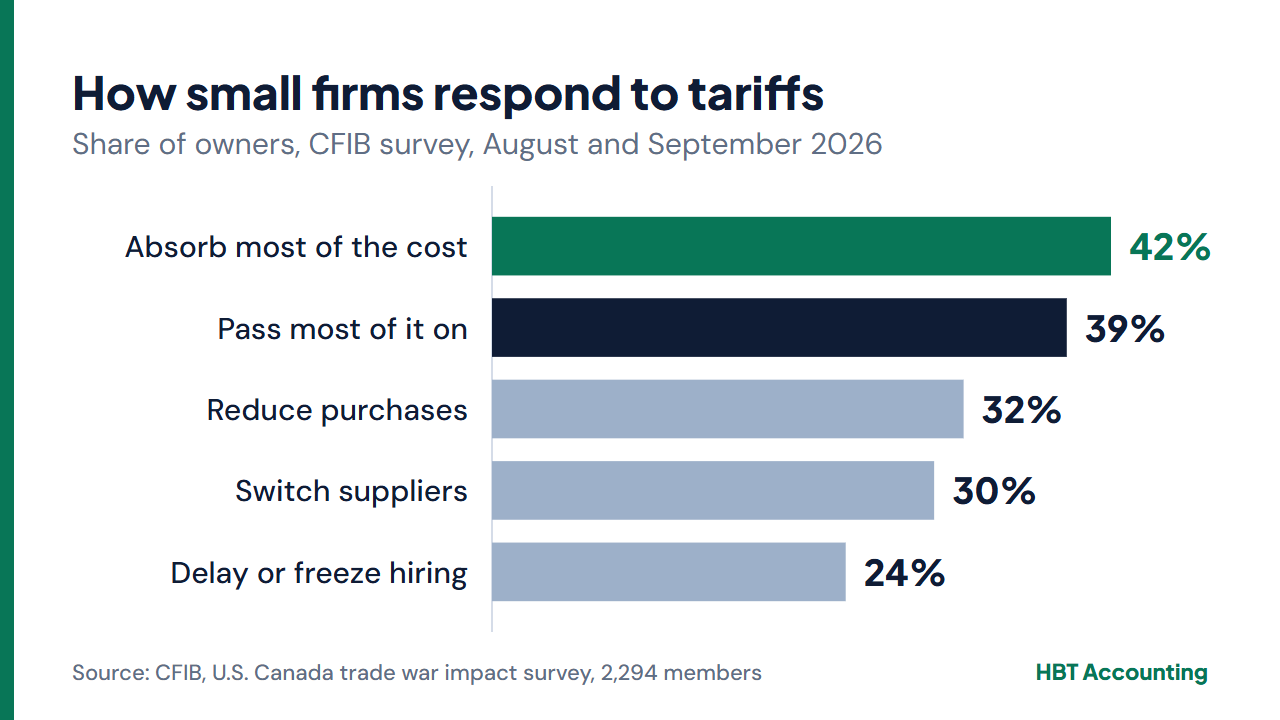
42%of small business owners in CFIB's survey of 2,294 members in late August and early September 2026 expect to absorb most of the new tariff costs, and 39% expect to pass most of them on.
By HBT AccountingSources checked 6 min read
Key points
- Statistics Canada found 59.8% of businesses expected cost related obstacles in the third quarter of 2026, down from 64.3%
- Statistics Canada reported 27.4% of businesses passed tariff costs to customers over a year, 37.7% did not, 34.9% had none
- The Bank of Canada raised its policy rate to 2.5% in October 2026, citing surveys that suggest more cost pass through
- In the guide's illustration, a 10% cost rise cuts profit per unit by 23% when the price is held
Costs and prices in the survey data
Cost pressure eased slightly in the third quarter of 2026 but stayed widespread. Statistics Canada's Canadian Survey on Business Conditions was fielded in July and early August 2026. It found that 59.8% of businesses expected cost related obstacles over the next three months, down from 64.3% in the second quarter. Inflation was the most common expected obstacle at 41.6%, and 7.2% named the cost of inputs as the most challenging.
The same release reported that the Raw Materials Price Index was 18.1% higher in July 2026 than a year earlier, while consumer prices were up 3.0% and average hourly wages 2.8%. About one in five businesses, 20.6%, expected to raise their own selling prices over the next three months. The shares were highest in accommodation and food services at 34.6%, wholesale trade at 29.6% and retail trade at 27.8%.
The Bank of Canada's Business Outlook Survey for the third quarter of 2026 was based on interviews with about 100 firms between August and early September 2026. It found that expected growth in input and selling prices moderated but remains high. Roughly half of firms, more than in the previous quarter, said they plan to pass on some or all of the cost increases linked to the war in the Middle East and tariffs. Competitive pressure continues to limit how far firms can raise prices. The text of the Bank's report does not give results for small firms separately.
In October 2026 the Bank raised its policy rate by 0.25 percentage points to 2.5%. It said CPI inflation had been around 3% since April and that its surveys suggest cost pass through will increase over the next year.
How tariffs reach small firms
Statistics Canada found that nearly one in three businesses, 32.2%, expected U.S. tariffs on Canadian goods to have a negative impact on their business over the next 12 months, whether or not they trade across the border. Another 46.9% expected no effect, 19.8% were unsure and 1.0% expected a positive effect. Expectations were highest in manufacturing at 49.7%, transportation and warehousing at 47.3% and wholesale trade at 45.1%.
That survey closed in early August 2026, before the new U.S. tariffs of 50% on $28 billion of Canadian goods that CFIB says took effect later that month. CFIB surveyed 2,294 of its members between late August and early September 2026, after they took effect.
In the CFIB survey, 26% of owners reported a major negative impact from the new U.S. tariffs, and 27% expected a major impact from Canada's retaliatory measures. Among exporters to the United States, 43% had at least one affected product, as did 47% of importers from the United States. CFIB's summary says 19% of affected exporters and 11% of affected importers expect to stop being financially viable within three months. CFIB's members are not a random sample, so these figures describe the owners who answered.
Canada's own surtax adds to import costs. Customs Notice 26-23 sets surtaxes of 15%, 25% or 50% on listed U.S. origin goods, effective September 8, 2026. GST is charged on the value for tax, which includes the surtax. In the notice's example, a good with a $150 value for duty under the 25% schedule carries $37.50 of surtax and $9.38 of GST.
| Measure | 1 to 4 employees | 5 to 19 employees | 20 to 99 employees |
|---|---|---|---|
| Inflation named as the most challenging obstacle | 14.6% | 10.3% | 8.2% |
| Cost of inputs named as the most challenging obstacle | 6.1% | 7.6% | 10.9% |
| Expect a major or minor negative impact from U.S. tariffs on imports of their goods | 27.8% | 36.9% | 38.7% |
| Expect a major negative impact from Canadian tariffs on goods bought from U.S. businesses | 26.2% | 35.3% | 44.0% |
How owners are responding
Owners are split on absorbing or passing on tariff costs. In CFIB's survey 42% expected to absorb most of the new costs and 39% expected to pass most of them through. Statistics Canada asked about all tariff related cost increases over the past 12 months. It found 27.4% of businesses had passed them to customers, 37.7% had not and 34.9% had no such increases. Looking ahead, 30.4% said they were very or somewhat likely to pass costs on.
Prices are one lever among several. CFIB found 32% of owners had reduced or were considering reducing purchases or imports affected by tariffs, and 30% had switched or were considering switching suppliers or sourcing locations. Owners could pick more than one measure. Smaller shares were delaying or freezing hiring (24%), delaying or cancelling investments (23%) and renegotiating contracts with customers or suppliers (15%).
The Bank of Canada's October 2026 survey described firms changing suppliers, sourcing inputs from other countries and spending more on automation to offset trade related costs. Among firms interviewed after trade talks broke down, more reported higher costs than higher selling prices.
Repricing arithmetic
A cost increase and the price increase needed to cover it are not the same size when margins are thin. The illustration below uses round numbers that are not from any survey. A product sells for $100 and costs $70, so gross profit is $30 and the gross margin is 30%. If the cost rises 10% to $77 and the price stays at $100, profit per unit falls to $23.
Holding the dollar profit takes a 7% price rise, because $7 of extra cost has to be recovered. Holding the 30% margin takes the full 10% and lifts profit per unit to $33. Absorbing the whole cost increase gives up about 23% of profit per unit, a larger share than the 10% rise in cost suggests.
Higher prices can lose sales. At $110 a business selling 100 units a month could lose about 9 of them and still earn the original $3,000, since $3,000 divided by $33 is about 91 units. If customers would leave in larger numbers, a smaller increase, a cheaper input or a longer supplier payment term can ease the squeeze on cash instead.
| Scenario | Price | Cost | Profit per unit | Gross margin | Monthly profit |
|---|---|---|---|---|---|
| Before the cost increase | $100 | $70 | $30 | 30.0% | $3,000 |
| Cost up 10%, price held | $100 | $77 | $23 | 23.0% | $2,300 |
| Price raised to hold the dollar profit | $107 | $77 | $30 | 28.0% | $3,000 |
| Price raised to hold the 30% margin | $110 | $77 | $33 | 30.0% | $3,300 |
Supplier terms and the books
Tariff costs are easier to manage when they can be seen. Recording duties and surtaxes on imported inputs in a separate account shows how much of a margin change comes from tariffs and how much from supplier price changes.
Contracts matter as much as shelf prices. One construction owner quoted in CFIB's report said signed contracts cannot be changed and the extra cost will have to be absorbed. Shorter quote validity periods, price adjustment clauses and early talks with suppliers about price locks or longer payment terms are ways to share the risk.
Quick answers
Are Canadian small businesses raising prices because of tariffs?
Some are. Statistics Canada found 27.4% of businesses had passed tariff related cost increases to customers over 12 months, and 30.4% were very or somewhat likely to do so over the next 12 months. CFIB found 39% of owners expected to pass most of the new tariff costs through.
How much do prices need to rise if costs go up 10%?
It depends on the margin and on what customers will pay. In this guide's illustration, a product costing $70 and selling for $100 needs about $107 to keep the same dollar profit and $110 to keep the same 30% margin after a 10% cost rise.
What is the Bank of Canada policy rate?
It was 2.5% as of November 2026, after the Bank raised it by 0.25 percentage points in October 2026. The Bank said CPI inflation had been around 3% since April.
Does GST apply to the Canadian surtax on U.S. goods?
The CBSA says GST is calculated on the value for tax, which includes the surtax. GST is not payable on goods that are not taxable for GST, even if a surtax applies.
What share of small businesses say U.S. tariffs will hurt them?
Statistics Canada found 27.8% of businesses with 1 to 4 employees expected a major or minor negative impact from U.S. tariffs on imports of their goods over the next 12 months. The shares were 36.9% for businesses with 5 to 19 employees and 38.7% for those with 20 to 99.
Related pages
Official sources
- Bank of Canada: Business Outlook Survey, Third Quarter of 2026
- Bank of Canada: Bank of Canada raises the policy rate by 25 basis points to 2½%
- Statistics Canada: Canadian Survey on Business Conditions, third quarter 2026
- Statistics Canada: How are small businesses doing
- CBSA: Customs Notice 26-23, United States Surtax Order (2026)
- CFIB: Special survey on the U.S.-Canada trade war, Impact on small businesses of Section 338 tariffs and retaliatory tariffs, Final results
Call or email and we will tell you which records we need and what the work costs, in writing, before anything starts.
Important. This article provides general educational information, not legal or tax advice for a specific business. Rules, administrative policies, rates and deadlines can change. Confirm your facts and current obligations with the responsible government agency and a qualified adviser.