
Research briefs
Why New Canadian Businesses Close and What Separates Those That Last
68.0%of new Canadian small businesses were still operating five years after they started, on average across cohorts, ISED reported in Key Small Business Statistics 2025 in January 2026.
By HBT AccountingSources checked 6 min read
Five year survival
ISED's Key Small Business Statistics 2025 tracked new businesses with 1 to 99 employees created between 2001 and 2022. On average across cohorts, 94.8% were still active one year after creation, 79.9% after three years and 68.0% after five. Not every cohort can be observed for the full period, so ISED averages the rates for the cohorts available at each age. The gap by sector was small, with 69.7% of goods producing businesses and 67.5% of services producing businesses still operating at five years.
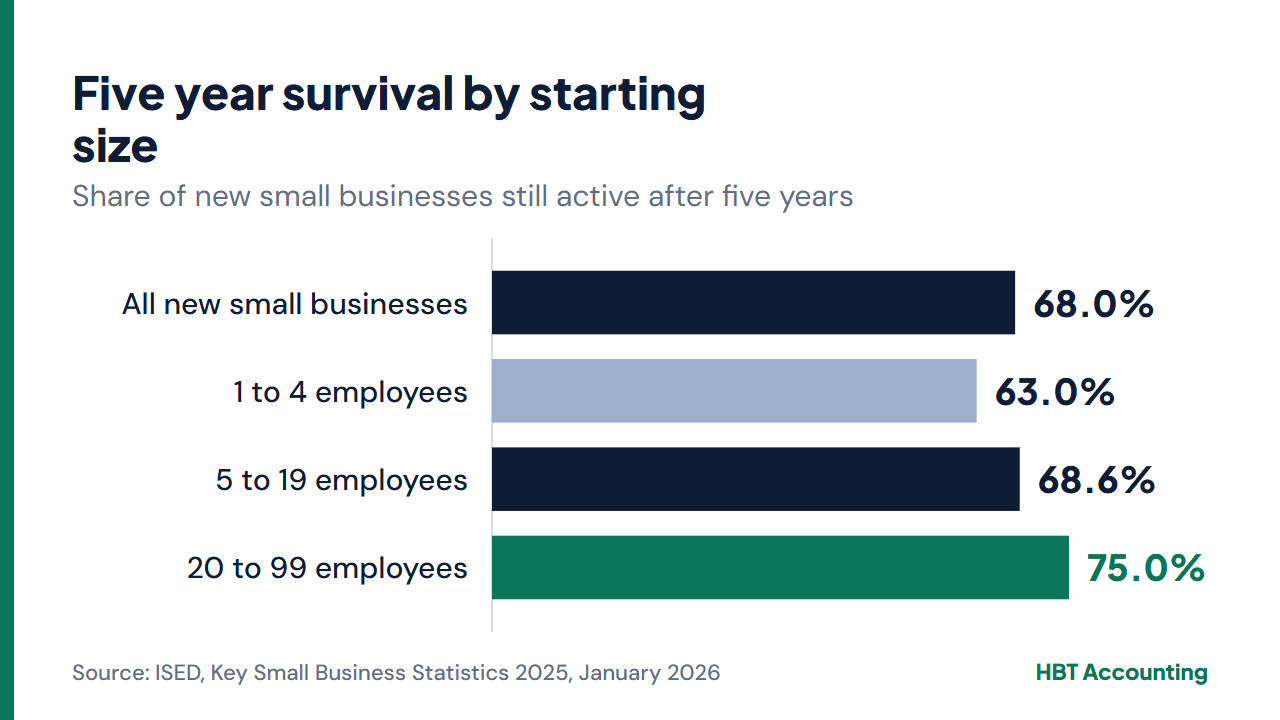
Size at the start matters. Businesses that began with 20 to 99 employees were 12 percentage points more likely than the smallest to be active at five years, at 75.0% against 63.0%. The smallest firms also account for nearly all closures. Of the small businesses that exited in 2018 to 2022, 94.1% had 1 to 4 employees, and on average 93,240 exited each year while 105,001 were created.
| Employees at the start | After 1 year | After 3 years | After 5 years |
|---|---|---|---|
| All new small businesses | 94.8% | 79.9% | 68.0% |
| Goods producing sector | 94.4% | 80.5% | 69.7% |
| Services producing sector | 94.9% | 79.7% | 67.5% |
| 1 to 4 employees | 92.0% | 74.7% | 63.0% |
| 5 to 19 employees | 96.9% | 81.1% | 68.6% |
| 20 to 99 employees | 98.1% | 85.4% | 75.0% |
Key points
- ISED reports 68.0% of new small businesses survive five years, and 63.0% of those that start with 1 to 4 employees
- CFIB says exits have outpaced entries since early 2024, and 55% of owners would not advise starting a business
- Statistics Canada put the 2023 exit rate at 11.9%, up from 10.8% a year earlier, against an entry rate of 12.3%
- A Management Science study of small firms in three developing countries found better business practices predicted higher survival
Exits are outpacing starts
Statistics Canada's business and employment dynamics data, released in February 2026, put the 2023 entry rate at 12.3%, down from 13.9% in 2022. The exit rate was 11.9%, up from 10.8% in 2022, which was the lowest on record. The number of active businesses grew 0.5% in 2023, against 3.1% in 2022. Business insolvency filings rose 41.4% from 2022 to 2023.
CFIB, using Statistics Canada's experimental estimates of business openings and closures, said in April 2026 that business exits have consistently exceeded new entries since early 2024. It called the pattern an entrepreneurial drought. Exit rates reached 5.6% in the second quarter of 2025, while entry rates fell to 4.8%, a figure its text dates to the fourth quarter of 2025. The same report said the share of small businesses struggling with borrowing costs rose from around 20% in early 2022 to nearly 30% by early 2026. It added that nearly a third report limited working capital.
Equifax Canada's June 2026 release said the volume of active young businesses, those 24 months old or younger, fell 38.7% in its first quarter 2026 data. It said the drop may indicate that operating costs, persistent inflation and wider economic conditions are hurting new enterprise creation. The release does not state the comparison period, and it does not report business exits.
In CFIB's October 2025 survey of 2,548 owners, 55% said they would not advise someone to start a business now, 20% said they would and 25% were unsure. Among those who said now is a bad time, 91% pointed to high costs of doing business, 84% to an uncertain economy and 70% to uncertainty around trade.
Evidence on practices and cash buffers
Evidence on why some small firms last is thinner than the evidence on how many do. A 2017 study in Management Science by David McKenzie and Christopher Woodruff built 26 survey questions on marketing, stock keeping, record keeping and financial planning. Using panel data from three developing countries, it found that better business practices predicted higher survival rates and faster sales growth. The link held after accounting for the owner's human capital. Variation in practices explained about as much of the variation in sales, profits and productivity among microenterprises as among larger firms. The firms were small and micro businesses in developing countries, so the results do not describe Canadian firms directly.
Cash buffers can also be measured. A 2016 JPMorgan Chase Institute study of about 600,000 small businesses with Chase accounts in United States metropolitan areas found that the median business held enough cash to cover 27 days of typical outflows. The median was 16 days for restaurants, 20 for construction and 47 for real estate, and the middle half of businesses ranged from 13 to 62 days. The data are from 2015.
The first study links practices to survival. The second describes buffer sizes and does not study survival. Neither shows that records or cash cause a firm to last. Firms that keep better books or hold more cash may also be better managed in other ways.
Numbers to check every month
The sources reviewed give a benchmark for only two of the numbers below, but all of them can be read from the monthly books and tracked from month to month. Each is quick to produce once the books are current.
In an illustration with round numbers, a business with $30,000 in the bank and an average of $1,500 going out each day has 20 days of cash. That is 7 days below the US median in the study above. The same business with a receivables list showing $12,000 of $40,000 outstanding for more than 60 days can see at a glance where the cash is stuck, and which customers to call first.
The monthly review also has a legal side. The CRA treats payroll deductions withheld from employees and GST/HST collected from customers as deemed trust amounts. It says they cannot be used as cash flow and that it can collect them ahead of other creditors, so unremitted balances belong on the same page as the bank balance.
| Number | How it is found | Benchmark or note |
|---|---|---|
| Days of cash | Cash on hand divided by average daily cash going out | Median of 27 days for US small businesses with Chase accounts, 2015 data |
| Days to be paid | Average days from invoice to payment, with a list of invoices past due | Canadian small businesses waited 28.4 days to be paid and were paid 10.5 days late on average, September 2026 quarter |
| Gross margin | Sales less cost of goods sold, divided by sales | No single benchmark, because margins differ by industry and move when supplier prices or duties change |
| Payroll and GST/HST owing | Source deductions and sales tax collected but not yet remitted | The CRA treats these as deemed trust amounts that cannot be used as cash flow |
| Break even sales | Fixed costs divided by the gross margin percentage | Compare with sales in each of the last three months |
What an exit means
Closure is not the same as failure. Statistics Canada's monthly estimates of openings and closures use payroll deduction files, so a closure there means a business stopped appearing as an employer. The releases reviewed do not sort exits by cause, so the data cannot say how many owners sold, retired, went back to working alone or went bankrupt.
The survival figures also cover only businesses that start with employees. Businesses with no employees sit outside the ISED survival tables.
Quick answers
What percentage of new businesses in Canada survive five years?
ISED reports that 68.0% of new small businesses with employees were still active after five years, on average across cohorts, and 63.0% of those that began with 1 to 4 employees.
Why do small businesses close in Canada?
The data sources reviewed count closures but do not record causes. In CFIB's October 2025 survey, 91% of owners who said now is a bad time to start a business named high costs of doing business and 84% named an uncertain economy.
How many businesses close in Canada each year?
ISED counted an average of 93,240 small business exits a year from 2018 to 2022, against 105,001 created. Statistics Canada put the 2023 exit rate at 11.9%.
Does good bookkeeping help a business survive?
A Management Science study of small firms in three developing countries found that better practices, including record keeping and financial planning, predicted higher survival. It does not prove cause, and it does not cover Canadian firms.
Is a closed business the same as a failed business?
No. Statistics Canada tracks entries and exits from payroll records and does not give reasons. An exit can be an owner who sold, retired or stopped employing staff as well as one who went bankrupt.
Related pages
Official sources
- ISED: Key Small Business Statistics 2025
- Statistics Canada: Business and employment dynamics data, 2023
- CFIB: Canada's Entrepreneurial Drought, Part 2, Fixing Canada's Shrinking Business Landscape
- Equifax Canada: Canadian Entrepreneurship Declines, Challenges Build As Companies Fall Behind with Lenders
- NBER: Business Practices in Small Firms in Developing Countries, McKenzie and Woodruff, Management Science 2017
- JPMorgan Chase Institute: Cash is King, Flows, Balances, and Buffer Days
- Xero: Canadian small business sales up for four months straight, a glimmer of hope after a tough 18 months
- CRA: Information on deemed trust
Call or email and we will tell you which records we need and what the work costs, in writing, before anything starts.
Important. This article provides general educational information, not legal or tax advice for a specific business. Rules, administrative policies, rates and deadlines can change. Confirm your facts and current obligations with the responsible government agency and a qualified adviser.