Research briefs
Prompt Payment Laws for Construction in Canada: Deadlines, Notices and Holdbacks
28 daysis how long an owner has to pay a proper construction invoice in Alberta and Ontario, unless a notice of dispute goes out within 14 days, under the Alberta Act as consolidated to April 2025 and the Ontario Act as of November 2026.
By HBT AccountingSources checked 8 min read

Key points
- Alberta and Ontario owners must pay a proper invoice in 28 days or give notice of dispute within 14 days
- Contractors have 7 days from receiving payment to pay subcontractors, or 35 days after invoicing if the owner does not pay
- Holdback is 10% in both provinces, and Ontario now requires accrued holdback to be released after each contract anniversary
- British Columbia passed its Construction Prompt Payment Act in November 2025, but it was not yet in force in November 2026
From invoice to payment
In Alberta and Ontario an owner who receives a proper invoice must pay it within 28 days. A contractor that has been paid then has 7 days to pay each subcontractor, and the same 7 day step repeats down the chain. The federal Act for construction on federal real property also gives the Crown 28 days, but it counts every later step from the day the Crown received the invoice.
This guide covers Alberta, Ontario and the federal Act in detail and notes where Saskatchewan, Manitoba and British Columbia stand. It does not cover Quebec, the Atlantic provinces or the territories. Alberta's Prompt Payment and Construction Lien Act has applied to new contracts since August 29, 2022, Ontario's prompt payment rules since October 1, 2019, and the federal Act since December 9, 2023.
A proper invoice is a defined document. Alberta's list includes the contractor's name and address, the invoice date, a description of the work, the amount requested and a statement that the document is meant to be a proper invoice. In both provinces a contract clause that makes an invoice depend on prior certification or owner approval has no effect, apart from an exception for testing and commissioning.
| Step | Alberta | Ontario | Federal Act |
|---|---|---|---|
| Owner pays a proper invoice | 28 days after receiving it | 28 days after receiving it | By the 28th day after the Crown receives it |
| Owner's notice to withhold | Notice of dispute within 14 days | Notice of non payment within 14 days | Notice of non payment by the 21st day |
| Contractor pays subcontractor | 7 days after receiving payment, or 35 days after the invoice went to the owner | 7 days after receiving payment, or 35 days after the invoice went to the owner | By the 35th day after the Crown receives the invoice |
| Subcontractor pays the next tier | 7 days after receiving payment, or 42 days after the invoice went to the owner | 7 days after receiving payment, or 42 days after the invoice went to the owner | By the 42nd day, then 7 more days for each lower tier |
| Interest on late amounts | Accrues at prescribed rates | Prejudgment interest rate, or the contract rate if higher | Regulation rate, or the contract rate if higher |
Notices that stop the clock
An owner that disputes an invoice can refuse to pay all or part of it, but only by giving the contractor notice in the prescribed form within 14 days of receiving the invoice. The notice must state the amount not being paid and give all the reasons. Alberta's Act calls it a notice of dispute and Ontario's a notice of non payment. In both provinces the undisputed part of the invoice is still due within 28 days. The federal Act gives the Crown 21 days to send its notice.
The notice then travels down the chain. A contractor that was not paid because of the owner's notice can hold back from a subcontractor only by giving its own notice and undertaking to start adjudication within 21 days. It must also pass on a copy of the owner's notice. A contractor that disputes what a subcontractor is owed can send a notice with its reasons, within the timelines the statute sets.
Adjudication and interest
Adjudication is the fast track for payment disputes. Alberta's Act makes the adjudicator's determination binding unless a court directs otherwise, an arbitrator rules or the parties settle in writing, and it leaves the merits open to a court or arbitrator later. Ontario's statute calls the process interim adjudication.
In Alberta, notice of adjudication must be given within 30 days after final payment unless the parties agree otherwise. The Alberta government names two nominating authorities, ARCANA and ADACC, and parties choose one when they sign the contract. In Ontario, notice must be given within 90 days after the contract is completed, abandoned or terminated. The adjudicator must decide within 30 days of receiving the documents, a period that can be extended.
The federal Act lets an unpaid contractor or subcontractor seek a determination from an adjudicator. Notice is due by the 21st day after the later of the certificate of completion and the end of the payment period on the last proper invoice. The payer must pay within 10 days of the determination unless it sets another time, and an unpaid payee may suspend work.
Holdbacks
Prompt payment rules sit beside the older lien rules, and holdback is where the two meet. Alberta's Act requires an owner making a payment to retain 10% of the value of the work and materials. The owner holds it for 60 days after the certificate of substantial performance, or after completion where none is issued. The period is 90 days for improvements to oil or gas wells and well sites and for concrete work. Ontario requires each payer to retain 10% of the price of services or materials as they are supplied, plus a separate 10% holdback on finishing work after substantial performance.
Release timing is where the provinces now differ most. Ontario's section 26 has been in force since January 1, 2026. It requires the owner to publish a notice of annual release within 14 days after each anniversary of the contract date. The owner then pays the accrued basic holdback between 60 and 74 days after the notice, subject to exceptions where liens exist. For a contract signed before section 26 took effect, the first release falls on the second contract anniversary after that date and covers all holdback accrued by then. In Alberta, annual or phased release applies only if the contract provides for it, the price exceeds a prescribed amount, no liens are outstanding and any other prescribed conditions are met. The Alberta government's page gives that test as contracts of at least $10 million running more than 12 months.
The federal Act allows holdback if the contract provides for it, but not more than the construction law of the project's province allows. The GST/HST and income tax treatment of holdbacks is covered in the contractor tax guide linked below.
| Item | Alberta | Ontario |
|---|---|---|
| Basic holdback | 10% for 60 days after substantial performance or completion, 90 days for oil or gas well work and concrete | 10% of the price as supplied, until liens have expired or been dealt with, plus a separate 10% on finishing work |
| Release | Annual or phased only if the contract provides, above a prescribed price | Notice within 14 days after each contract anniversary, payment 60 to 74 days after the notice |
| Time to start adjudication | 30 days after final payment | 90 days after completion, abandonment or termination |
| Time to decide | Not stated in the Act, which leaves procedures to the regulations and the nominating authority | 30 days after the adjudicator receives the documents, extendable |
What late payment looks like
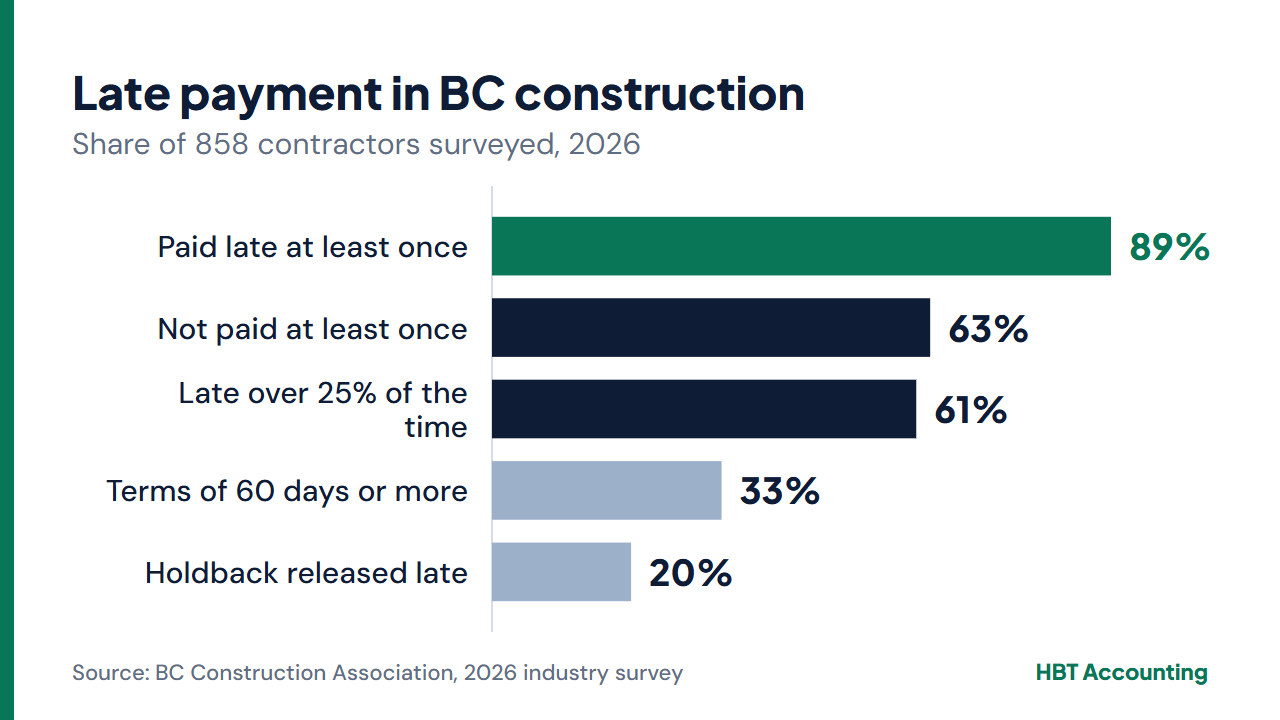
National figures on how long contractors wait are hard to find, and the Canadian Construction Association's prompt payment page carries no survey statistics. The closest recent numbers come from the BC Construction Association, whose 2026 industry survey drew 858 respondents between October and December 2025. In it, 89% said they had been paid late at least once for completed work, and 61% said they were paid late more than 25% of the time.
The same survey found that 63% had not been paid at least once for work they completed, and 33% had contracts with average payment terms of 60 days or more. A fifth of companies said a 10% lien holdback was rarely or never released on time. These figures describe one province's industry, which had no prompt payment statute in force when the survey ran, and they do not measure how well the Alberta or Ontario rules work.
Other provinces and practical steps
Saskatchewan brought its prompt payment amendments into force on March 1, 2022 for new contracts, with the same 28 day and 7 day steps. Manitoba proclaimed the remaining provisions of its prompt payment amendments in force on April 1, 2025. British Columbia's Construction Prompt Payment Act received Royal Assent in November 2025, and the province says regulations and an adjudication authority are still to be developed. The federal Act can step aside in a province whose regime the government designates as reasonably similar, but it still applies to projects that cross provincial borders.
Alberta government project contracts fall under the Public Works Act, so a public project needs a check on which statute governs. Because the clocks start when a proper invoice is received, a log of invoice dates, notices received and amounts held back shows when interest begins and when a 14 day or adjudication window closes. How a given contract, holdback or dispute is treated depends on its facts and its province.
Quick answers
How long does an owner have to pay a contractor in Canada?
In Alberta and Ontario, 28 days after receiving a proper invoice. The federal Act also uses 28 days for federal construction work. An owner who disputes the invoice must give notice within 14 days in Alberta and Ontario and within 21 days under the federal Act.
How long does a contractor have to pay subcontractors?
In Alberta and Ontario, 7 days after the contractor receives payment. If the owner pays late or not at all, the fallback is 35 days after the invoice went to the owner, unless the contractor gives a proper notice of non payment.
What is the holdback on a construction contract in Alberta and Ontario?
Both provinces require 10%. Alberta holds it for 60 days after substantial performance or completion, or 90 days for oil and gas well work and concrete. Ontario requires release after each contract anniversary on a set schedule.
Does prompt payment legislation apply in British Columbia?
Not yet as of November 2026. The Construction Prompt Payment Act received Royal Assent in November 2025, and the province says regulations and an adjudication authority still have to be put in place before it takes effect.
Does the federal prompt payment law apply to provincial projects?
No. It applies to construction work on federal real property or federal immovables. Provincial projects follow the province's own statute.
Related pages
Official sources
- Alberta King's Printer: Prompt Payment and Construction Lien Act, RSA 2000, c P-26.4
- Government of Alberta: Prompt payment rules for construction industry
- Government of Ontario: Construction Act, R.S.O. 1990, c. C.30
- Justice Laws: Federal Prompt Payment for Construction Work Act, S.C. 2019, c. 29, s. 387
- BC Construction Association: 2026 BC Construction Industry Survey
- Province of British Columbia: Prompt payment legislation
- Government of Saskatchewan: Legislation to Protect Contractors Takes Effect Today
- Government of Manitoba: Proclamation, The Builders' Liens Amendment Act (Prompt Payment), S.M. 2023, c. 30
Call or email and we will tell you which records we need and what the work costs, in writing, before anything starts.
Important. This article provides general educational information, not legal or tax advice for a specific business. Rules, administrative policies, rates and deadlines can change. Confirm your facts and current obligations with the responsible government agency and a qualified adviser.