Research briefs
Business Fraud and CRA Scams in Canada: How They Work and the Controls That Stop Them
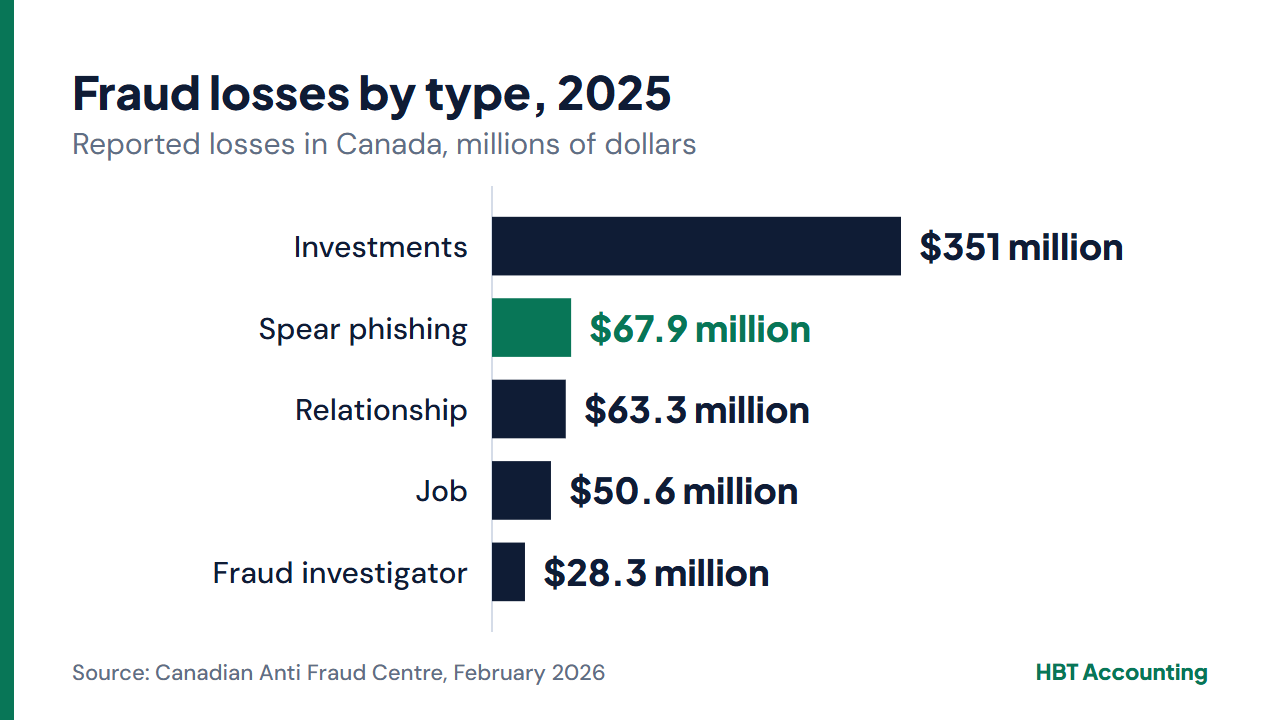
$67.9 millionwas reported lost to spear phishing in 2025, the second largest dollar loss of any fraud type in Canada, the Canadian Anti Fraud Centre reported in February 2026.
By HBT AccountingSources checked 7 min read

Fraud losses in 2025 and 2026
The Canadian Anti Fraud Centre reported over 112,000 fraud reports and more than $704 million in reported losses for 2025. Investment fraud led at $351 million. Spear phishing, the category that covers payment redirection and impersonation of executives or suppliers, came second at $67.9 million from 813 reports and 571 victims. The centre's home page showed $535 million lost in the first nine months of 2026.
The centre's top ten list does not split categories by victim type, so it does not show how much of any row was lost by businesses. Spear phishing is the category its page on frauds against businesses describes. A separate Payments Canada survey of 500 Canadian businesses, published in September 2024, was run through Leger's online panel in March and April 2024. It found that 20% had met payment fraud in the previous six months and 15% had lost money. Impersonator fraud made up 25% of the payment fraud businesses reported, followed by intercepted business Interac transfers at 22%. Small businesses reported fraud at 16% and larger commercial businesses at 26%. Among businesses that lost money, 71% were partly or fully reimbursed.
| Fraud type | Reports | Victims | Reported loss |
|---|---|---|---|
| Investments | 4,409 | 3,867 | $351 million |
| Spear phishing | 813 | 571 | $67.9 million |
| Relationship | 1,093 | 933 | $63.3 million |
| Job | 2,148 | 1,726 | $50.6 million |
| Fraud investigator | 2,167 | 1,137 | $28.3 million |
| Recovery pitch | 933 | 569 | $25.9 million |
| Extortion | 2,767 | 835 | $23 million |
Key points
- Canadians reported $704 million lost to fraud in 2025, and $535 million in the first nine months of 2026
- Spear phishing, where a fraudster poses as an executive or supplier, drew 813 reports and $67.9 million in 2025 losses
- The CRA texts only for multi factor authentication, never demands payment by gift card or cryptocurrency, and never threatens arrest
- Banks and the fraud centre advise confirming any change to banking details through a known contact, not through the message itself
How the CRA contacts people
The CRA says it may contact taxpayers by phone, automated message, letter or email. A caller may ask you to confirm your identity with details such as your name, date of birth or Social Insurance Number. A call that asks for information is therefore not proof of a scam. The warning signs are the payment method and the pressure.
The CRA states that it will not demand or pressure immediate payment by Interac transfer, cryptocurrency, prepaid credit cards or gift cards. It will not threaten to deport, arrest or imprison anyone, and it will not set up an in person meeting in a public place to collect a payment. It will not ask for personal or financial information in a voicemail or email, and it does not charge a fee to speak to an agent.
Email and text are tightly limited. The CRA emails only if you registered for notifications and have a new message, asked for a link or form during a call with an agent, or subscribed to an electronic mailing list. Its emails do not come from a named individual, ask you to reply or include a link asking for personal or financial information. It texts only for multi factor authentication, and only if you chose the telephone option. It does not use WhatsApp or Facebook Messenger.
To check a contact, hang up and find an official number yourself, look for messages in your CRA account, or type the address instead of clicking a link. Official CRA addresses start with canada.ca, and the CRA warns that scammers use hyphens to build look alike addresses.
How payment redirection works
The Canadian Anti Fraud Centre describes spear phishing and payment redirection this way. A fraudster infiltrates or spoofs an email account, sets a rule that copies incoming mail to an account they control, studies how the owner communicates and strikes when the owner is hard to reach. Its first example is a message that seems to come from a senior executive asking accounts payable for an urgent payment. Its second is a message that seems to come from an existing contractor, with new payment details and an invoice to pay.
Scotiabank's September 2026 article adds that attackers who take over a real business mailbox can use accurate invoice details to redirect client payments, and can intercept replies to delay detection. It recounts a July 2025 case in which a law firm in the Vancouver area wired $2.3 million to a fraudulent Hong Kong account, and the funds were later intercepted and returned. RBC's February 2026 article separates business email compromise from vendor email compromise, where a criminal takes over or imitates a vendor's email account and sends invoices that divert payments.
Scam types and the control that stops each
The table pairs each pattern with the control that the Canadian Anti Fraud Centre, the Canadian Centre for Cyber Security, the CRA or a bank recommends against it.
| Scam type | How it works | The control that stops it |
|---|---|---|
| Supplier bank change | A message from a known supplier supplies new bank details with an invoice that looks genuine | Confirm any change by phone on a number already on file before the first payment, and have a second person approve |
| Executive impersonation | A message that seems to come from a senior person asks accounts payable for an urgent payment | Send urgent or unusual payments through a second approval path, kept separate from the email thread |
| Email account takeover | A criminal enters a mailbox, copies incoming mail and waits for a moment to redirect a payment | Multi factor authentication on email and banking, unique passwords of 12 characters or more, a check of sender addresses |
| CRA impersonation by phone | A caller claims a tax debt and presses for immediate payment, with threats of arrest | Hang up, then check your CRA account or call an official number; never pay by gift card, cryptocurrency or prepaid card |
| Fake CRA email or text | A message with a link asks for personal, bank or card details | Type the address yourself; real CRA emails never ask for a reply or include a link asking for personal or financial information |
| Ransomware | A phishing attachment or link locks the business's files until a payment is made | Tested backups kept offline, automatic updates, anti malware tools and staff training |
Payment approval and bank change checks
Most of these controls separate the person who receives a request from the person who confirms it. Scotiabank advises independent confirmation before vendor banking details are updated, a second approval path for urgent or unusual payments, limited access to payment systems and verified contact details kept apart from email threads. RBC advises calling back on a number from official or earlier records rather than the one in the message. It also advises asking for details only the real sender would know, such as an earlier order or invoice number, and reconciling bank accounts daily.
Here is a simple illustration. A long standing supplier emails new account details two days before an $18,000 payment is due. Under these controls the payment waits. Someone phones the supplier on the number already in the vendor file, records who confirmed and when, and a second person releases the payment.
The Canadian Centre for Cyber Security lists six foundational actions for small organizations. They are unique passwords of at least 12 characters with multi factor authentication, and automatic updates. They also include tested backups stored offline, preventative security tools, staff training and an incident response plan, with contact details written down and reachable even if systems are down.
If money has already moved
The CRA asks people to report scams or identity theft through its report a scam page or through reportcyberandfraud.canada.ca. It asks them to report fraud to local police and the Canadian Anti Fraud Centre. If they find unauthorized changes to a CRA account, they should contact the CRA as soon as possible. For a payment already sent, the bank is the first call. RBC advises reporting unauthorized items to the financial institution immediately.
Keep the email thread, the invoice, the bank details and a record of who approved the payment, because those records help whoever investigates. The statistics above count only what is reported, so the true totals are likely higher.
Quick answers
How does the CRA contact taxpayers?
By phone, automated message, letter or email. It emails only in three cases, such as when you registered for notifications and have a new message, and it texts only for multi factor authentication if you chose the telephone option.
Will the CRA ever demand payment by gift card or cryptocurrency?
No. The CRA says it will not demand or pressure immediate payment by Interac transfer, cryptocurrency, prepaid credit cards or gift cards, and it will not threaten arrest or deportation.
How do I check a supplier's change of bank details?
Phone the supplier on a number you already hold, not one in the email. The Canadian Anti Fraud Centre recommends verbal authentication for any urgent request or change in payment details, and Scotiabank adds a second approval path for urgent or unusual payments.
How much do Canadians lose to fraud each year?
The Canadian Anti Fraud Centre recorded more than $704 million in reported losses for 2025 and $535 million in the first nine months of 2026. These are reported losses only.
Where do I report business fraud or a CRA scam?
Report to your local police and the Canadian Anti Fraud Centre. For CRA related scams, also use the CRA's report a scam page or reportcyberandfraud.canada.ca, and tell your bank at once if money has moved.
Related pages
Official sources
- Canadian Anti-Fraud Centre: Top 10 frauds in 2025
- Canadian Anti-Fraud Centre: Home page, the impact of fraud so far this year
- Canadian Anti-Fraud Centre: Frauds targeting businesses
- CRA: Recognize a scam
- Canadian Centre for Cyber Security: Foundational cyber security actions for small organizations (ITSAP.10.300)
- Scotiabank: Business Email Compromise, Why Every Business Should Treat Trust as a Control
- RBC: Protect Your Business from Impersonator Fraud, Spot It and Stop It
- Payments Canada: One in five Canadian businesses experienced payment fraud in the past six months
Call or email and we will tell you which records we need and what the work costs, in writing, before anything starts.
Important. This article provides general educational information, not legal or tax advice for a specific business. Rules, administrative policies, rates and deadlines can change. Confirm your facts and current obligations with the responsible government agency and a qualified adviser.