Research briefs
Small Business in Canada by the Numbers: Counts, Jobs, Provinces and Industries
1.08 millionsmall businesses with 1 to 99 employees operated in Canada in December 2024, 98.2% of employer businesses, ISED reported in Key Small Business Statistics 2025 in January 2026.
By HBT AccountingSources checked 5 min read

Key points
- ISED counted 1,079,188 small businesses with employees in December 2024, 98.2% of all employer businesses in Canada
- Small businesses employed 5.8 million people in 2024, 46.6% of private sector employees, according to ISED
- Statistics Canada counted 3.78 million non employer businesses with revenue over $30,000 in June 2026, against 1.37 million with employees
- Ontario and Quebec hold about 59% of small businesses, and construction is the largest industry with 154,179
How many small businesses Canada has
ISED's Key Small Business Statistics 2025, published in January 2026, counted 1,099,521 businesses with employees in Canada in December 2024. Of those, 1,079,188, or 98.2%, were small, meaning they had 1 to 99 paid employees. Another 16,953 (1.5%) were medium sized, with 100 to 499 employees, and 3,380 (0.3%) were large, with 500 or more.
Most small businesses are very small. Micro enterprises with 1 to 4 employees make up 59.1% of employer businesses, and those with 1 to 9 employees make up 77.3%. A business with 10 or more employees therefore sits among the largest 22.7% of employer businesses, a figure calculated from ISED's shares. By sector, 76.6% of employer businesses produce services and 23.4% produce goods.
Definitions differ by publisher. Statistics Canada's small business article uses the same band of 1 to 99 employees and splits it into 1 to 4, 5 to 19 and 20 to 99. The Canada Small Business Financing Program instead tests gross annual revenue of $10 million or less.
The counts are not comparable with earlier editions of the report. ISED now defines a business at the enterprise level, where older editions counted establishments and locations from Statistics Canada's Canadian Business Counts. It warns against comparing the Section 1 figures with the 2023 edition and earlier.
Businesses with no employees
ISED's report generally leaves out businesses with no paid employees. Statistics Canada's Canadian business counts include them where annual revenues are above $30,000. The June 2026 release, published in August 2026, counted 1.37 million employer businesses and 3.78 million non employer businesses. On those figures about 73% of the businesses in the register have no employees.
Non employer businesses grew by about 300,000 between December 2024 and June 2026, while employer businesses were nearly flat. Statistics Canada cautions that changes between periods can reflect administrative or methodological changes in the Business Register rather than real shifts.
The two employer totals, 1.37 million from Statistics Canada and about 1.10 million from ISED, are not comparable. Statistics Canada usually counts operating locations, and ISED counts enterprises.
| Reference month | Employer businesses | Non employer businesses |
|---|---|---|
| December 2024 | 1.36 million | 3.48 million |
| December 2025 | 1.37 million | 3.67 million |
| June 2026 | 1.37 million | 3.78 million |
By province and territory
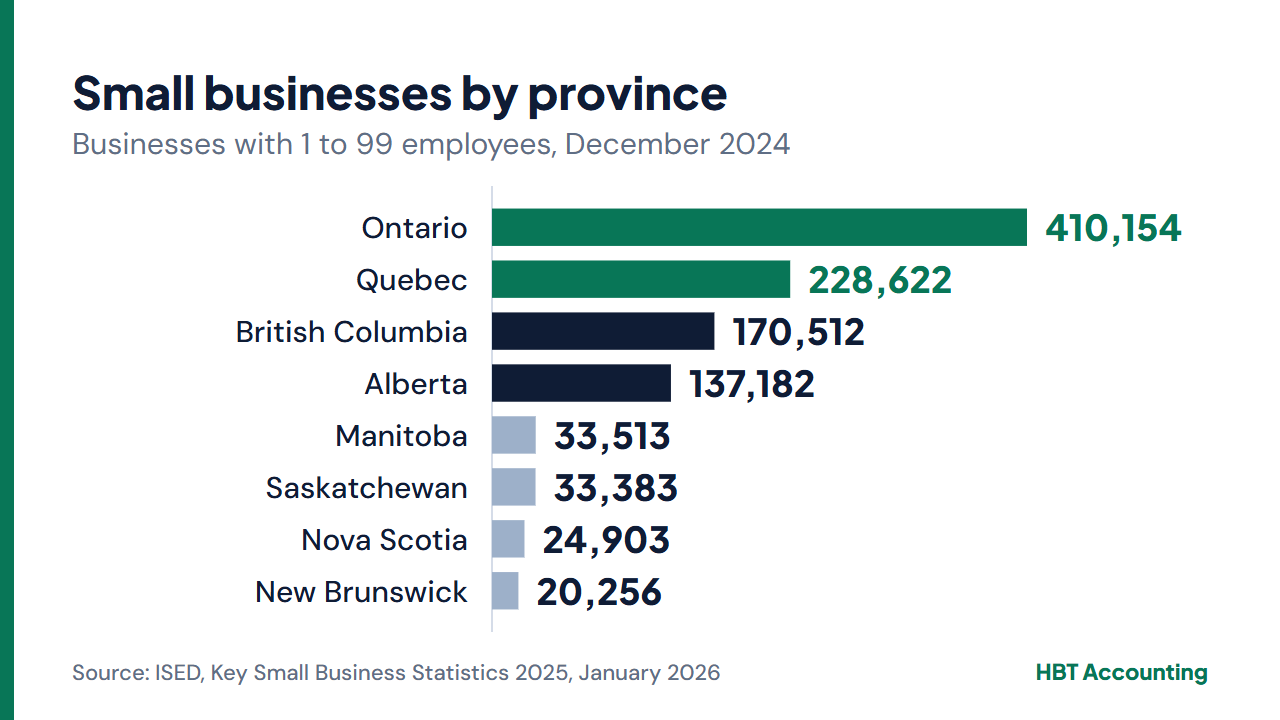
Ontario had 410,154 small businesses in December 2024, 38.0% of the national total, and Quebec had 228,622, or 21.2%. British Columbia had 170,512 and Alberta 137,182. Together Ontario and Quebec hold about 59% of the national total.
Small businesses made up between 96.8% of employer businesses in the territories and 98.5% in Newfoundland and Labrador and Saskatchewan.
Private sector jobs are similarly concentrated. Ontario and Quebec account for 7,738,748 of them, or 61.8% of the national total.
| Province or territory | Small businesses | Share of Canada's small businesses |
|---|---|---|
| Ontario | 410,154 | 38.0% |
| Quebec | 228,622 | 21.2% |
| British Columbia | 170,512 | 15.8% |
| Alberta | 137,182 | 12.7% |
| Manitoba | 33,513 | 3.1% |
| Saskatchewan | 33,383 | 3.1% |
| Nova Scotia | 24,903 | 2.3% |
| New Brunswick | 20,256 | 1.9% |
| Newfoundland and Labrador | 12,626 | 1.2% |
| Prince Edward Island | 5,246 | 0.5% |
| Territories | 2,791 | 0.3% |
| Canada | 1,079,188 | 100.0% |
By industry and jobs
Four industries account for 533,478 employer businesses, or 48.5% of the total. They are construction, professional, scientific and technical services, health care and social assistance, and other services except public administration. Retail trade adds 98,812, or 9.0%.
Small businesses employed 5.8 million private sector workers in 2024, 46.6% of a private workforce of 12.5 million. The share varies sharply by industry. Small businesses held 78.9% of jobs in other services and 70.4% in construction, but 15.6% in finance and insurance.
The industries left out of the table are smaller by count. Administrative and support services has 50,158 employer businesses and wholesale trade 39,196. Finance and insurance has 25,905, arts, entertainment and recreation 17,359, educational services 14,661 and information and cultural industries 12,580. Mining, quarrying and oil and gas extraction has 6,056, public administration 5,217, management of companies 3,165 and utilities 770.
Small businesses make up 99% or more of employer businesses in agriculture, construction, real estate, professional services and other services. Public administration has the lowest share at 78.7%, followed by utilities at 91.9%.
| Industry | Small businesses | Small business employees (thousands) | Share of the industry's private sector jobs |
|---|---|---|---|
| Construction | 154,179 | 830.7 | 70.4% |
| Professional, scientific and technical services | 150,105 | 641.6 | 52.2% |
| Other services, except public administration | 103,576 | 451.9 | 78.9% |
| Retail trade | 96,799 | 875.7 | 43.7% |
| Accommodation and food services | 75,553 | 868.6 | 66.8% |
| Transportation and warehousing | 69,089 | 275.0 | 32.6% |
| Real estate and rental and leasing | 50,458 | 180.9 | 61.6% |
| Manufacturing | 44,440 | 551.6 | 35.3% |
| All industries | 1,079,188 | 5,838.5 | 46.6% |
Output, exports and growth
Small businesses contributed 33.2% of the GDP generated by the private sector in 2022, according to ISED, and small and medium sized businesses together accounted for nearly half. Averaged over 2018 to 2022, SMEs accounted for 47.8% of the value added to economic activity.
In 2024, 48,036 Canadian enterprises exported goods, and 73.3% of them were SMEs. ISED's share of high growth firms for 2019 to 2022 was 3.3% by employment and 8.1% by revenue, slightly more than double.
What the numbers leave out
The counts come from the Business Register, which Statistics Canada compiles mainly from CRA tax records. A business is counted as active until its tax accounts are closed or dormant for an extended period, so the register can lag real closures. An employer business is one that remitted payroll deductions at any point in the previous 12 months.
Health care and social assistance has 119,783 small businesses, and agriculture, forestry, fishing and hunting has 46,832. Neither appears in ISED's private sector jobs table. Statistics Canada's non employer count leaves out businesses with annual revenues of $30,000 or less.
Quick answers
How many small businesses are there in Canada?
ISED counted 1,079,188 small businesses with 1 to 99 paid employees in December 2024, 98.2% of 1,099,521 employer businesses. Including businesses with no employees, Statistics Canada counted 3.78 million more in June 2026.
How many Canadian businesses have no employees?
Statistics Canada counted 3.78 million non employer businesses with annual revenues above $30,000 in June 2026, against 1.37 million businesses with employees. That is about 73% of all businesses in the register.
What counts as a small business in Canada?
ISED defines a small business as one with 1 to 99 paid employees and a medium sized business as one with 100 to 499. Large businesses have 500 or more. Other programs use their own definitions, such as a revenue limit.
What share of Canadian jobs are with small businesses?
Small businesses employed 5.8 million people in 2024, which is 46.6% of private sector employees, according to ISED. The figure excludes the public sector.
Which province has the most small businesses?
Ontario, with 410,154 small businesses in December 2024, or 38.0% of the national total. Quebec follows with 228,622, then British Columbia with 170,512 and Alberta with 137,182.
Related pages
Official sources
- ISED: Key Small Business Statistics 2025
- ISED: SME Research and Statistics, publications in 2026
- Statistics Canada: Canadian business counts, June 2026
- Statistics Canada: Canadian business counts, December 2025
- Statistics Canada: Canadian business counts, December 2024
- Statistics Canada: How are small businesses doing
- ISED: Canada Small Business Financing Program, Helping small businesses get loans
Call or email and we will tell you which records we need and what the work costs, in writing, before anything starts.
Important. This article provides general educational information, not legal or tax advice for a specific business. Rules, administrative policies, rates and deadlines can change. Confirm your facts and current obligations with the responsible government agency and a qualified adviser.