Research briefs
What Lenders Look At Before Approving a Small Business Loan in Canada
1.25is the debt service coverage ratio RBC says business borrowers should aim to reach or beat, in its August 2026 guidance on strengthening a financing application.
By HBT AccountingSources checked 6 min read

What a lender asks to see
A lender approving a small business loan is answering one question, which is whether the business will generate enough cash to repay it. BDC calls cash flow the most important indicator. It says the bank will review financial statements, usually for the last couple of years, and compare them with industry averages. RBC adds that a new business has no statements to point to, so its projections must be reasonable and achievable, backed by evidence such as supplier quotes. RBC also says lenders want enough working capital to cover fixed costs during slow periods, including the months before a new business earns revenue.
CIBC says a first time borrower may need the last two years of the owner's notices of assessment and T1 returns, business financial statements for the same period and two year cash flow projections. It also lists items such as a lease, articles of incorporation and GST/HST registration documents.
| Document | What a lender looks for |
|---|---|
| Business financial statements, last two years | Profit trend, cash generated and existing debt, compared with industry averages |
| Personal notices of assessment and T1 returns | Owner income and tax standing, asked for the last two years by CIBC |
| Personal and business financial documents for the legal structure | The set of documents that fits how the borrower is organized, whether a corporation, a partnership or a sole proprietorship |
| Cash flow projections | Whether the plan is reasonable and achievable, and whether the numbers rest on evidence |
| Accounts receivable aging | How much is current, which balances are 90 days or more past due, and how much counts toward a borrowing base |
| Payables and balances owed to government | Amounts with legal priority, such as sales taxes, source deductions and wages, which BDC subtracts from borrowing capacity |
| Schedule of existing debt | Current term debt payments and interest, the amount cash flow must cover in the debt service ratio |
| Credit reports | The owner's personal credit behaviour and the business's own score, which reflects reports from suppliers and lenders |
| Security and guarantees | Assets that can be pledged as security, and a personal guarantee where security falls short |
| Registrations and agreements | Articles of incorporation or partnership agreement, lease, GST/HST registration and identification |
Key points
- RBC's August 2026 guidance says to aim for a debt service coverage ratio of 1.25 or higher
- BDC says banks look at financial statements for the last couple of years, personal and business credit, collateral and cash flow
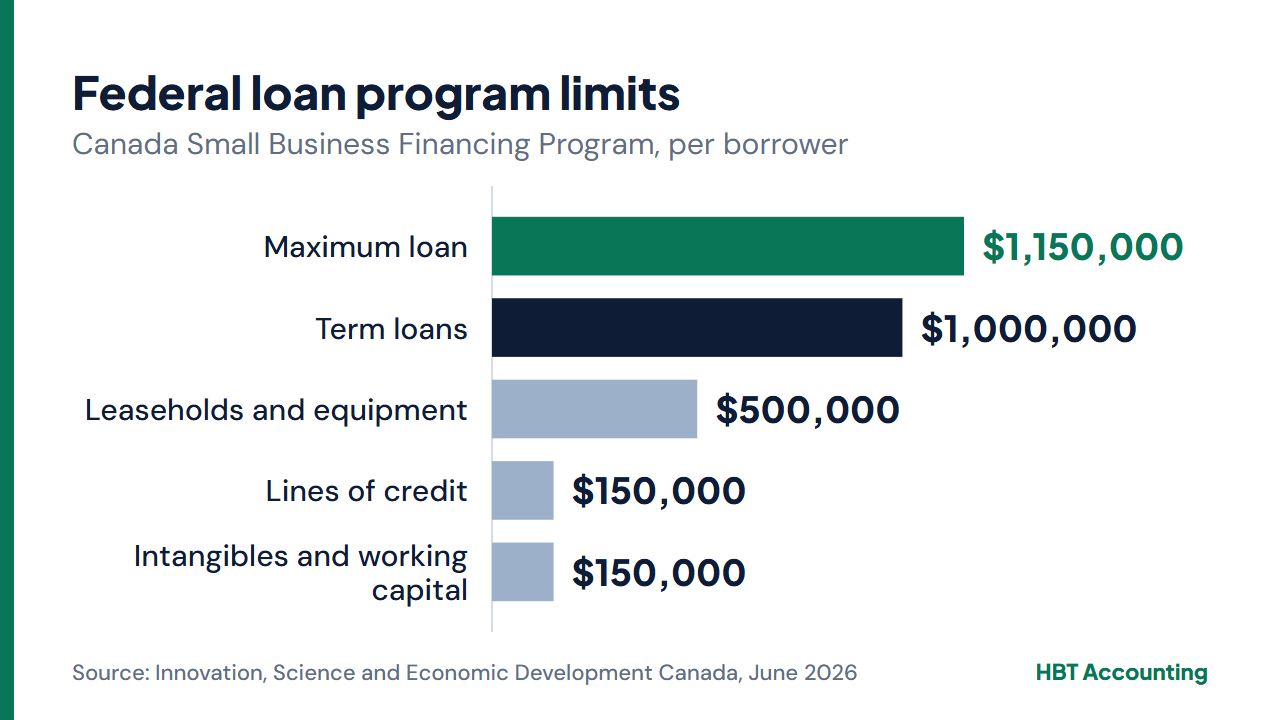
- Under the Canada Small Business Financing Program, ISED reports a $1.15 million maximum per borrower and $150,000 for lines of credit
- ISED's 2025 Credit Conditions Survey found 97% of small businesses that requested debt financing were approved, in full or in part
The ratios behind the decision
Lenders turn those documents into a few ratios, and RBC names three. The current ratio, current assets divided by current liabilities, should be above 1, and many lenders like to see between 1.5 and 2. Debt to tangible net worth, total debt divided by tangible net worth, should be 3 or less. Debt service coverage, net operating income divided by total debt service, should be 1.25 or higher.
BDC defines the coverage ratio more strictly. It starts with adjusted EBITDA, subtracts income taxes, distributions paid and unfunded capital spending, and divides the result by the current portion of term debt plus interest. Distributions to owners therefore reduce the ratio.
BDC also gives a rule of thumb that borrowing capacity is guided by net income plus depreciation, less annual repayments on existing term debt. RBC advises lining up tax decisions with financing needs. Reported income feeds both calculations, which makes the timing of owner pay, dividends and tax planning a financing question as well as a tax one.
In the illustration below, an extra $30,000 of owner distributions moves the ratio from 1.30, above RBC's 1.25 guide, to 1.00, which leaves no cushion. Lenders set their own minimums and calculate the ratio in different ways.
| Line | Case A | Case B |
|---|---|---|
| Adjusted EBITDA | $200,000 | $200,000 |
| Less income taxes | $25,000 | $25,000 |
| Less owner distributions | $35,000 | $65,000 |
| Less unfunded capital spending | $10,000 | $10,000 |
| Cash available for debt service | $130,000 | $100,000 |
| Principal and interest due | $100,000 | $100,000 |
| Debt service coverage ratio | 1.30 | 1.00 |
Receivables, payables and the operating line
For an operating line of credit, BDC explains that the bank recalculates a borrowing base each month. Eligible receivables plus eligible inventory, less senior debt, give the borrowing capacity. Receivables outstanding for 90 days or more are often excluded, and the bank counts a percentage of what remains. In BDC's worked example, 75% of $865,000 of eligible receivables gives $648,750.
Senior debts such as sales taxes, source deductions and wages are subtracted. The usable line therefore moves with receivables, so slow collections can shrink what a business can draw even when sales are steady. A receivables aging report with few balances near 90 days, and current payroll and GST/HST remittances, gives the bank less to exclude or subtract.
Compilation, review and audit
Financial statements can carry three levels of assurance. CPA Quebec describes an audit as providing reasonable assurance that the statements are free from material misstatement, a review as providing limited assurance through inquiry and analytical procedures, and a compilation as providing none. A compilation arranges the client's information into statements and checks the arithmetic without verifying the information.
The CPA Quebec page does not say which level lenders require. Lenders set their own requirement, and the sources reviewed for this guide do not set a rule. The practical step is to ask the lender which level it accepts before the statements are prepared.
Government backed loans and the cost of borrowing
The Canada Small Business Financing Program shares lending risk with banks and other lenders, which alone approve the loans. ISED reports a maximum of $1.15 million per borrower, made up of up to $1,000,000 in term loans and up to $150,000 in lines of credit. No more than $500,000 of a term loan can go to leasehold improvements and equipment, and no more than $150,000 to intangible assets and working capital.
Eligible borrowers are small businesses and startups with gross annual revenues of $10 million or less. Farming businesses are not eligible. The registration fee is 2% of the amount loaned. The maximum interest rate is the lender's prime rate plus 3% on floating rate term loans and prime plus 5% on lines of credit.
RBC lists security or a personal guarantee among the usual requirements and suggests that, where security is short, a smaller first request, a longer amortization, a silent shareholder or a guarantor can help.
ISED's Credit Conditions Survey for 2025 collected data from more than 1,800 small employer businesses. About 20% requested debt financing, and 97% of those that asked were approved, in full or in part, up from 89% a year earlier. Those figures describe firms that chose to apply, which are not a random cross section of all small businesses.
Borrowing costs have also moved. The Bank of Canada raised its policy rate by 0.25 percentage points to 2.5% in October 2026.
Quick answers
What documents does a bank want for a small business loan?
CIBC says a first time borrower may need the last two years of business financial statements, personal notices of assessment and T1 returns, and two year cash flow projections. It also lists a lease, articles of incorporation and GST/HST registration documents, and requirements vary by lender and by the borrower's situation.
What is a good debt service coverage ratio for a small business?
RBC says to aim for 1.25 or higher, calculated as net operating income divided by total debt service. BDC uses a stricter version that subtracts taxes, distributions and unfunded capital spending, and each lender sets its own minimum.
How much can a business borrow under the Canada Small Business Financing Program?
ISED reports a maximum of $1.15 million per borrower, with term loans up to $1,000,000 and lines of credit up to $150,000. Eligible businesses have gross annual revenues of $10 million or less, and the lender approves the loan.
Does a lender need audited financial statements for a small business loan?
The sources reviewed set no such rule. Audits, reviews and compilations give different levels of assurance, and the lender decides which it accepts, so it is worth asking before the statements are prepared.
Do lenders look at accounts receivable?
For an operating line of credit, yes. BDC says the bank starts with eligible receivables, often excludes balances outstanding for 90 days or more, and applies a percentage to the rest.
Related pages
Official sources
- ISED: Canada Small Business Financing Program, Helping small businesses get loans
- ISED: Small Business Credit Condition Trends, 2015 to 2025
- Bank of Canada: Bank of Canada raises the policy rate by 25 basis points to 2½%
- BDC: How a bank looks at your business
- BDC: What amount can I use on my operating line of credit
- RBC: Before You Apply, Six Ways to Help Strengthen Your Business Financing Application
- CIBC: Applying for Your 1st Business Loan, Here's What to Expect
- CPA Quebec: CPAs and financial statements
Call or email and we will tell you which records we need and what the work costs, in writing, before anything starts.
Important. This article provides general educational information, not legal or tax advice for a specific business. Rules, administrative policies, rates and deadlines can change. Confirm your facts and current obligations with the responsible government agency and a qualified adviser.