
Research briefs
Selling a Business to an Employee Ownership Trust in Canada: The $10 Million Exemption
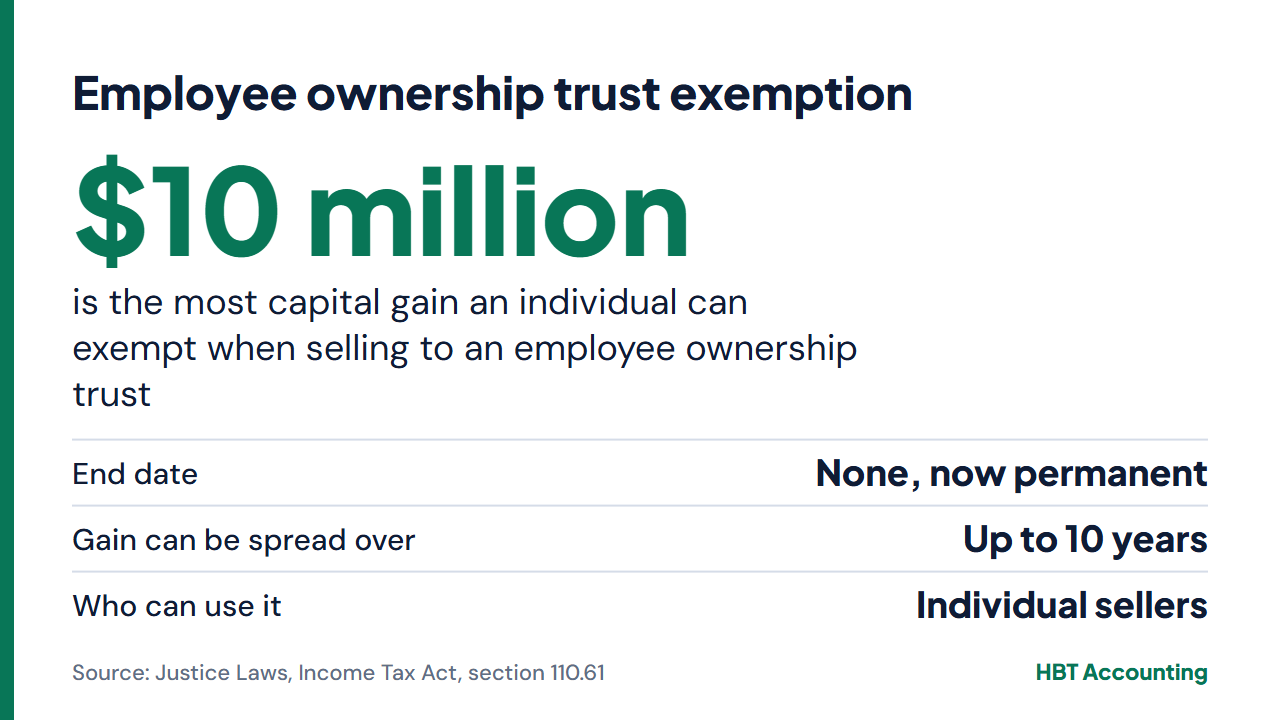
$10 millionis the most capital gain an individual can exempt when selling shares to an employee ownership trust, now with no end date since the Spring Economic Update 2026 Implementation Act received royal assent in June 2026.
By HBT AccountingSources checked 6 min read
The exemption and its status
An individual who sells shares of a corporation to an employee ownership trust can exempt up to $10 million of capital gains, subject to conditions. The exemption was introduced as a temporary measure for sales after 2023 and up to the end of 2026. The Spring Economic Update 2026 proposed making it permanent.
That proposal is now law. The Spring Economic Update 2026 Implementation Act, S.C. 2026, c. 22, received royal assent in June 2026, and its summary says it makes the exemption permanent for sales to an employee ownership trust or a worker cooperative. Section 3 of the Act replaces the opening of subsection 110.61(1) of the Income Tax Act, which now covers dispositions that occurred after 2023 and contains no end date.
Key points
- An individual can exempt up to $10 million of capital gains on selling shares to an employee ownership trust
- The exemption applies to dispositions after 2023 with no end date, after legislation passed in June 2026
- A gain that is not exempt can be spread over up to ten years, with at least 10% taxed each year
- Only individuals can claim the exemption, and the seller must deal at arm's length and give up control
Who can sell and what the sale must look like
The exemption belongs to individuals, not to holding companies or trusts. A corporation that owns the shares cannot claim it, because the claimant must be an individual other than a trust. A holding company structure therefore needs advice before any sale is planned. The table sets out the main conditions in section 110.61 and the definition of a qualifying business transfer.
| Condition | What the law says |
|---|---|
| Seller | An individual other than a trust, at least 18 at the time of the sale |
| Activity | The seller or a spouse or common law partner was regularly, continuously and substantially active in the business throughout a 24 month period that ended before the sale |
| Ownership | Unrelated persons did not own the shares in the 24 months before the sale, and more than half of asset value was in active business assets |
| Buyer | A trust, or a Canadian controlled private corporation the trust controls and wholly owns, that acquires control of the corporation |
| Arm's length | The seller deals at arm's length with the trust and the corporation, now and afterward, and keeps no right or influence that could give control |
| Business | All or substantially all of the corporation's asset value is in assets used mainly in an active business |
| Exclusions | The corporation and its affiliates cannot be professional corporations. At least 75% of the trust's beneficiaries must be resident in Canada |
| Election | The trust, any purchaser corporation and the seller jointly elect on Form T24EOT, naming an amount of up to $10 million |
What the trust must look like
The Income Tax Act defines an employee ownership trust in some detail. It must be resident in Canada and exist only for the benefit of employees of the qualifying businesses it controls. Employees can be excluded during a probationary period of up to 12 months, and former employees can be included if the trust says so.
No beneficiary can own, outside the trust, shares worth 10% or more of a class of the business. With related persons, the limit is 50% or more of a class. Capital and income interests must be allocated by the same method for every beneficiary, based on hours worked, pay or length of service.
Governance has set minimums. At least one third of the trustees must be employee beneficiaries, and each trustee has an equal vote. If any trustee is appointed other than through an employee election in the last five years, at least 60% of the trustees must deal at arm's length with each seller. More than half of the employee beneficiaries must approve a winding up, a merger, or a transaction that would remove at least 25% of beneficiaries. All or substantially all of the trust's value must come from the shares or debt of qualifying businesses it controls.
The reserve, the election and the clawback
A seller who is paid over time can use a longer reserve. Section 40 normally lets a taxpayer defer a gain over up to five years. For a qualifying business transfer, subsection 40(1.3) stretches this to ten years, so at least one tenth of the gain is taxed each year.
The joint election goes to the CRA on Form T24EOT before the seller claims the deduction, and the trust must file it by its filing due date for the year of the sale. If several individuals qualify, the election assigns each a percentage, and the total cannot pass 100%. The deduction is calculated on Form T2048 and claimed on line 25395 of the return.
The deduction is limited to the lesser of a formula based on the elected amount and the individual's net capital gains for the year, after certain losses. It is denied in some cases, including avoidance transactions and certain dividend stripping arrangements.
The exemption can be lost. If a disqualifying event, such as the trust ceasing to qualify, occurs within 24 months of the sale, the deduction is treated as never having applied. If it occurs in the following eight years, the trust is treated as having a capital gain equal to the elected amount.
Worker cooperatives
Section 110.62 sets the same $10 million ceiling and the same start, after 2023, for a qualifying cooperative conversion. That is a sale of shares to a worker cooperative that takes control of the business. The seller files Form T25QCC, and the deduction also goes on line 25395. A deduction under either section is not available if any individual has earlier sought one under either section for the same active business.
The buyer must meet the Act's definition of a worker cooperative. It must be resident in Canada and incorporated under cooperative legislation, and it must exist to provide employment to its members. At least 75% of its employees must hold membership shares, and at least one third of its directors must be workers. No more than 40% of its directors can be former owners, and at least 50% of surplus earnings must be paid out by pay earned or labour contributed.
The federal rules apply across Canada. Provincial and territorial tax treatment of the gain is set separately, so it needs to be confirmed for the province involved.
How owners see the option
CFIB's Passing the Torch report, published in October 2026, found that 28% of owners plan to sell to employees. It also found that only 8% of owners are familiar with employee ownership trusts, a figure from a separate CFIB survey of 1,611 owners in April 2026. Among owners with employees, 19% said they would be very or somewhat likely to consider a sale through one.
The exemption matters to many of them. Of owners with employees, 34% said it is highly or somewhat relevant to their interest, and 25% were unsure. CFIB's report notes that the federal government had recently proposed making the exemption permanent. That proposal has since become law.
Quick answers
Is the $10 million employee ownership trust exemption permanent?
Yes. The Spring Economic Update 2026 Implementation Act received royal assent in June 2026, and subsection 110.61(1) now covers dispositions after 2023 with no end date.
Can my holding company sell to an employee ownership trust and claim the exemption?
No. The exemption is for individuals other than trusts, so a corporation cannot claim it. The ownership structure should be reviewed with an advisor before a sale.
How long can tax on the gain be deferred?
Subsection 40(1.3) lets a seller spread the gain over up to ten years instead of five, with at least one tenth of the gain taxed each year.
Does the exemption apply to a sale to a worker cooperative?
Yes, under section 110.62, with the same $10 million ceiling. The two sections cannot both be used for the same active business.
Which CRA forms are involved?
Form T24EOT is the joint election, Form T2048 calculates the deduction, and the claim goes on line 25395. A worker cooperative sale uses Form T25QCC instead of T24EOT.
Related pages
Official sources
- Justice Laws: Income Tax Act, section 110.61
- Justice Laws: Income Tax Act, section 110.62
- Justice Laws: Income Tax Act, section 248
- Justice Laws: Income Tax Act, section 40
- Justice Laws: Spring Economic Update 2026 Implementation Act, S.C. 2026, c. 22
- Department of Finance Canada: Tax measures: Supplementary information, Spring Economic Update 2026
- CRA: Line 25395, Capital gains deduction for qualifying business transfer or qualifying cooperative conversions
- CFIB: Passing the Torch: How Canada's Small Business Owners Are Planning Their Exit and Why the Next Generation of Ownership Matters
Call or email and we will tell you which records we need and what the work costs, in writing, before anything starts.
Important. This article provides general educational information, not legal or tax advice for a specific business. Rules, administrative policies, rates and deadlines can change. Confirm your facts and current obligations with the responsible government agency and a qualified adviser.