Research briefs
Short Term Rental Taxes in Canada: Expense Rules, GST/HST and Platform Reporting
90 daysis the length below which a residential rental counts as a short term rental under section 67.7 of the Income Tax Act, which denies expense deductions for the days it breaks provincial or municipal rules.
By HBT AccountingSources checked 6 min read
The federal expense restriction
Section 67.7 of the Income Tax Act denies deductions for a non compliant short term rental. A short term rental is a residential property rented or offered for rent for less than 90 consecutive days. It is non compliant when the province or municipality does not permit it at that location. It is also non compliant when a registration, licence or permit is required and the rental does not meet all of the requirements. The CRA says the denial applies to income earned after 2023.
The denial works by days. The non compliant amount is the expenses that would otherwise be deductible, multiplied by the days the property was non compliant and divided by the days it was a short term rental. A rental that breaks the rules for half its rental days loses half its expenses. Compliant days keep their deductions.
Finance Canada explained the purpose in its notes on the bill. The measure supports provinces and municipalities that restrict short term rentals and gives owners an incentive to return properties to the long term market. It was not expected to raise significant revenue. The rule is section 67.7 of the Income Tax Act, added by 2024, chapter 17, and subsection 67.7(4) lets the CRA assess and reassess to give effect to it despite the usual time limits.
| Situation | Tax result |
|---|---|
| The province or municipality does not permit the rental at that location | Non compliant for those days. The matching share of expenses is not deductible |
| A registration, licence or permit is required and one is missing | Non compliant for those days. The matching share of expenses is not deductible |
| All registration, licence and permit requirements are met | Reasonable expenses are generally deductible for the period it was compliant |
| The rental was registered and licensed by December 31, 2024 | Treated as compliant for the whole of the 2024 taxation year |
| Rented for 90 consecutive days or more | Not a short term rental under the section, so the denial does not apply |
| Only part of the home is rented | Only the expenses that relate to the rented part of the home are deductible |
Key points
- Section 67.7 denies expense deductions for the days a rental under 90 consecutive days breaks provincial or municipal rules
- The rule applies from 2024, and a rental registered and licensed by December 31, 2024 counted as compliant for that year
- Stays under one month are subject to GST/HST, and registration is generally required above $30,000 over four calendar quarters
- Platforms have reported rental hosts to the CRA since 2024, with the first returns due January 31, 2025
A worked example from the CRA
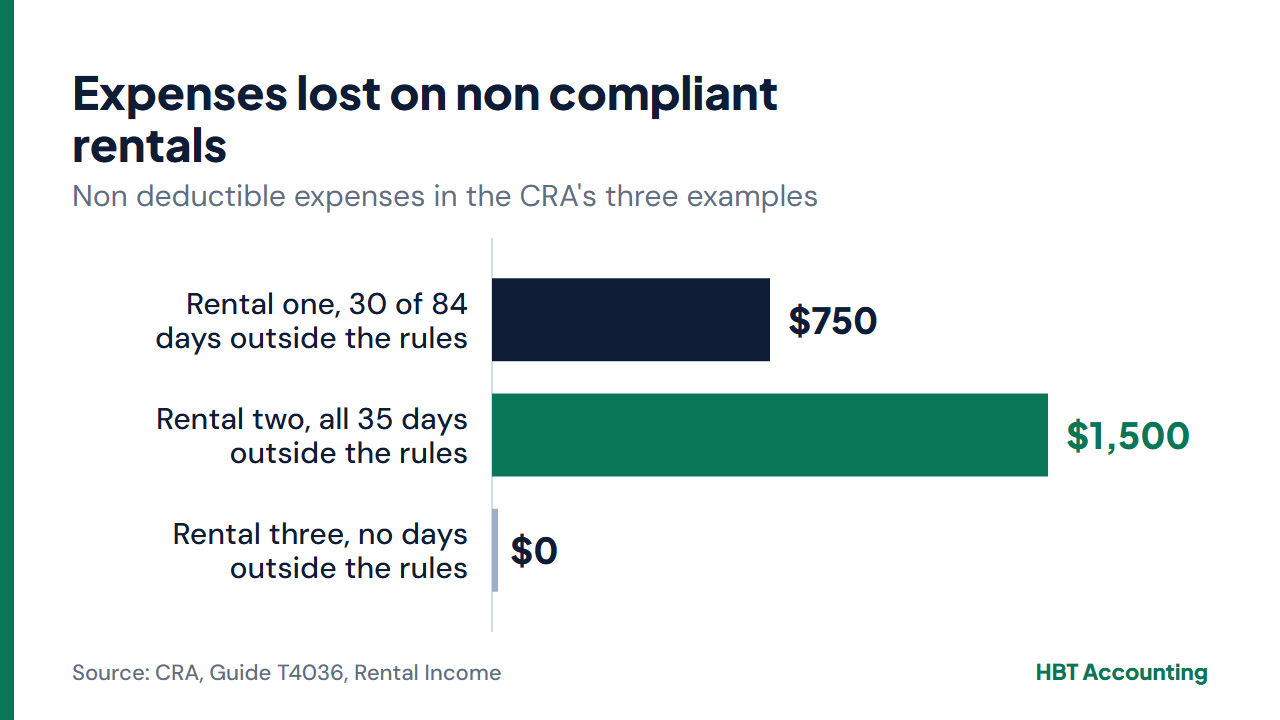
On Form T776 the owner totals the short term share of each expense on line 9365, completes Chart A and enters the non compliant amount on line 9366. The CRA's own example for 2025 has an owner with three rentals and $4,300 of short term expenses. Rental one had 30 non compliant days out of 84 and $2,100 of expenses, so $750 is not deductible. Rental two was non compliant for all 35 days and loses all $1,500. Rental three was compliant throughout and loses nothing.
The example shows why day level records matter. The CRA formula needs the days rented and the days the rental was non compliant for each unit. A booking calendar and the dates of each registration, licence or permit therefore matter as much as the expense receipts.
| Rental | Non compliant days | Short term rental days | Expense portion | Non deductible amount |
|---|---|---|---|---|
| One | 30 | 84 | $2,100 | $750 |
| Two | 35 | 35 | $1,500 | $1,500 |
| Three | 0 | 14 | $700 | $0 |
| Total | $4,300 | $2,250 |
GST/HST on short stays
The CRA says all income from an accommodation sharing arrangement is subject to income tax. It is usually rental income, reported on Form T776, and it can become business income, reported on Form T2125, as the host provides more services such as meals or cleaning.
For GST/HST, the CRA says stays of less than one month are subject to the tax and rentals of one month or more are exempt. A host generally has to register when gross revenue from accommodation sharing passes $30,000 over four calendar quarters, and can register earlier to claim input tax credits. The federal rules apply in every province, and the GST/HST rate depends on the province where the property is.
Platform reporting to the CRA
Part XX of the Income Tax Act, in force since January 1, 2024, makes digital platform operators report sellers to the CRA. The CRA guidance says rentals of immovable property are covered, both short term and long term, and that the first returns for calendar year 2024 were due January 31, 2025. For that first period, operators also had to give each seller the relevant information by the same date.
For a rental the report includes the host's name, address and tax identification number. It also includes the total paid per calendar quarter, the number of rentals, fees and taxes charged, and the address of each listing, with the days rented and the listing type where available. A seller who fails to give the operator a tax identification number can face a $500 penalty for each failure. A seller is excluded where the operator facilitated more than 2,000 rental services for one property listing in the period.
British Columbia and the market
Provincial and municipal rules decide what counts as compliant, and they differ across Canada. This guide covers the federal rules and British Columbia only. British Columbia gets detail because the province sets one principal residence rule for the communities it covers. The province limits short term rentals to the host's principal residence plus one secondary suite or accessory dwelling unit on the same property. This applies in municipalities with a population of 10,000 and over and in smaller neighbouring communities. Registration is per unit.
The requirement does not apply everywhere. The province exempts municipalities under 10,000 people that are not within 15 kilometres of a larger one, Resort Municipality Initiative communities, and mountain resorts, BC Parks resorts and ski resort areas. Whistler and Revelstoke are on its exempt list. Most regional district electoral areas and most Islands Trust areas are exempt too, with Salt Spring Island and Gabriola Island not exempt. The provincial rule is a minimum, so local governments may set stricter bylaws, and the province's list of covered communities is current as of June 2026. Other provinces and cities set their own tests, and the federal restriction follows whatever they set.
Desjardins Economic Studies reported in December 2023 that Canada had over 235,000 listings on popular short term rental platforms. That was about 1.4% of the housing stock and 4.9% of long term rentals, at a time when the long term rental vacancy rate was 1.9%. The authors recommended restricting commercial non principal residence rentals and enforcing penalties. The report was published before the federal rule took effect.
Quick answers
Can I deduct expenses on an Airbnb that breaks local rules?
Not for the non compliant days. Under section 67.7 the non compliant amount, worked out by days, is not deductible for income earned after 2023. Compliant days keep their deductions.
What counts as a short term rental for the federal rule?
A residential property rented or offered for rent for less than 90 consecutive days. It is non compliant if the location is not permitted or a required registration, licence or permit is not met.
Do I charge GST/HST on short stays?
The CRA says stays of less than one month are subject to GST/HST, and rentals of one month or more are exempt. Registration is generally required once gross accommodation revenue passes $30,000 over four calendar quarters.
Does the platform report my rental income to the CRA?
Yes. Under Part XX, operators have reported rental sellers since January 1, 2024. The first returns were due January 31, 2025, and operators had to give sellers the relevant information by the same date.
What does British Columbia require of hosts?
In covered communities, rentals are limited to the host's principal residence plus one secondary suite or accessory dwelling unit. Each unit is registered, and local bylaws may be stricter.
Related pages
Official sources
- Canada Revenue Agency: Rental Income
- Canada Revenue Agency: Sharing economy, Taxes and the platform economy
- Justice Laws: Income Tax Act (R.S.C., 1985, c. 1 (5th Supp.)), section 67.7
- Department of Finance Canada: Bill C-69, An Act to implement certain provisions of the budget tabled in Parliament on April 16, 2024
- Canada Revenue Agency: Guidance on the Reporting Rules for Digital Platform Operators
- Canada Revenue Agency: What information is shared, Reporting rules for digital platforms
- Province of British Columbia: B.C.'s short-term rental principal residence requirement
- Desjardins: Could Restricting Short-Term Rentals Help Alleviate Canada's Housing Crisis?
Call or email and we will tell you which records we need and what the work costs, in writing, before anything starts.
Important. This article provides general educational information, not legal or tax advice for a specific business. Rules, administrative policies, rates and deadlines can change. Confirm your facts and current obligations with the responsible government agency and a qualified adviser.