Research briefs
FHSA, RRSP or TFSA First: How the Three Accounts Compare for 2026
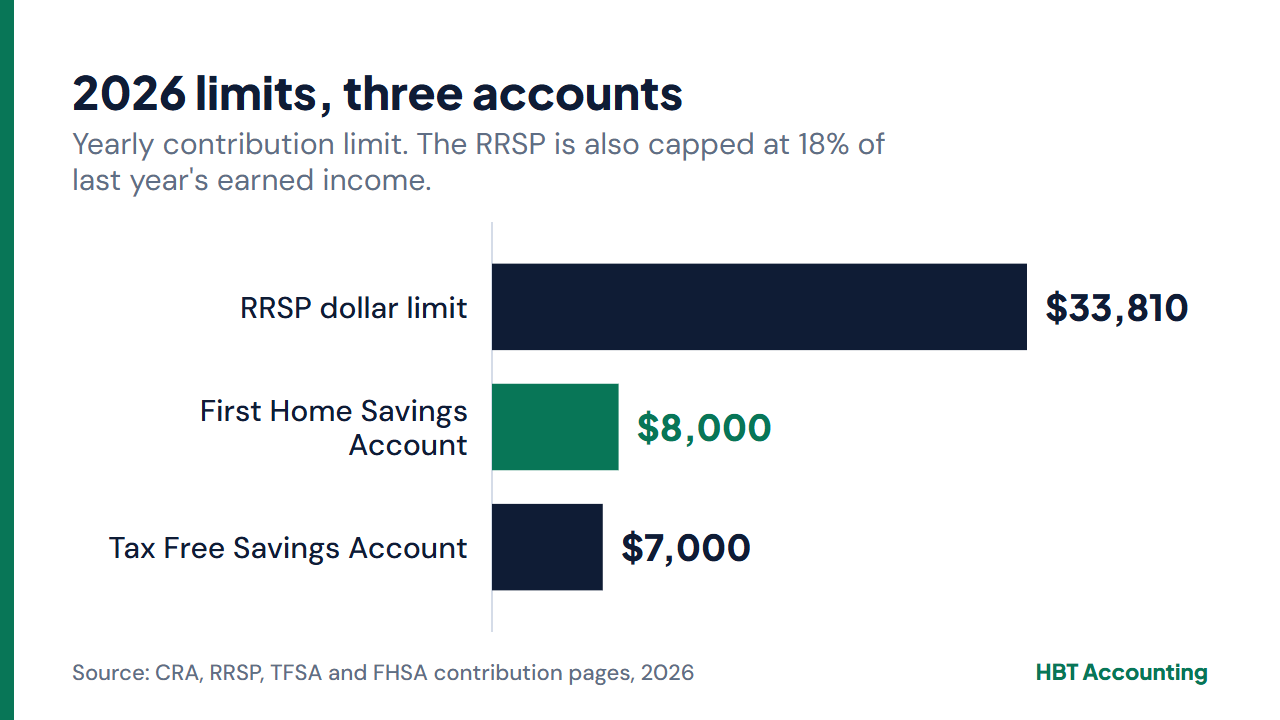
$8,000is the base annual room in a first home savings account, capped at $40,000 for life, against 2026 limits of $33,810 for an RRSP and $7,000 for a TFSA, per the CRA as of November 2026.
By HBT AccountingSources checked 6 min read
Key points
- The FHSA allows $8,000 of new room a year and $40,000 for life, and unused room carries forward up to $8,000
- For 2026 the RRSP limit is $33,810 and the TFSA limit is $7,000, and the RRSP deadline is March 1, 2027
- Contributions to the FHSA and RRSP are deductible, qualifying FHSA and TFSA withdrawals are generally tax free, RRSP withdrawals are income
- An April 2026 Canadian Tax Observatory report found 61.4% of 2023 FHSA contributors had income above $60,000
How the three accounts compare
For a first home, the First Home Savings Account is the only one of the three that pairs a deduction on the way in with tax free qualifying withdrawals. It allows only $8,000 of new room a year and $40,000 in total. The RRSP gives a deduction and taxes withdrawals. The TFSA gives no deduction and no tax bill. The table sets out the rules for 2026.
These are federal rules and apply in every province and territory. Provincial tax rates change what a deduction is worth, and the CRA's figures here are general. The details depend on the saver's age, income and housing history.
| Feature | FHSA | RRSP | TFSA |
|---|---|---|---|
| Limit for 2026 | $8,000, plus unused room carried forward up to $8,000 | The lesser of 18% of the previous year's earned income and $33,810, less any pension adjustment, plus unused room | $7,000, plus unused room |
| Total room | $40,000 for life | Unused room carries forward with no end date | $109,000 for 2026 for a person 18 and resident since 2009 who never contributed |
| Deduction on contribution | Yes, claimed by the account holder | Yes, and contributions not deducted can be claimed in a later year | No |
| Tax on withdrawal | Qualifying withdrawals are tax free, other withdrawals are income | Included in income for the year withdrawn | Generally tax free |
| Room after a withdrawal | Qualifying withdrawals are not repaid, and all FHSAs close by December 31 of the following year | Home Buyers' Plan withdrawals up to $60,000 are repaid over 15 years | Can be put back the next calendar year or when room is available again |
| Who can use it | Resident of Canada, 18 or older, who meets the first time buyer test | Contributions until December 31 of the year the holder turns 71 | Room starts at 18 for residents |
Where the FHSA fits
The FHSA is built around one event. A holder who qualifies as a first time buyer can open the account, deduct contributions and take a qualifying withdrawal toward a qualifying home. For the CRA, a first time buyer is someone who did not live in a qualifying home owned by them or their spouse or common law partner. The test covers the current calendar year and the previous four.
Unused annual room carries forward, but only up to $8,000. In the year the first account is opened the carry forward is zero, so the most that can go in during any year is $16,000, and only after a year with nothing contributed. Going over the room attracts a tax of 1% a month on the highest excess amount.
A qualifying withdrawal needs a written agreement to buy or build and a home acquired no more than 30 days before the withdrawal. The purchase or completion must come before October 1 of the year after the withdrawal, and the holder must intend to live in the home within one year. The holder gives Form RC725 to the issuer and closes all FHSAs by December 31 of the year after the first qualifying withdrawal.
If no home is bought, the account still ends. The participation period finishes on December 31 of the earliest of the 15th anniversary of opening the first FHSA, the year the holder turns 71, and the year after a first qualifying withdrawal. Money can move by direct transfer to an RRSP or RRIF without tax when there is no excess amount, and any other withdrawal is income in the year received.
The RRSP and the Home Buyers' Plan
The RRSP limit is the lesser of 18% of the previous year's earned income and the dollar limit, $33,810 for 2026, less pension adjustments, added to unused room. The CRA says unused room carries forward indefinitely and that contributions can be deducted in a later year. Contributions that count for 2026 can be made until March 1, 2027. The last year to contribute is the year the holder turns 71.
Money taken out of an RRSP has to be included in income for the year it is withdrawn. The Home Buyers' Plan is the exception built for a first home. The CRA gives the withdrawal limit as $60,000, repaid over 15 years. For first withdrawals between January 1, 2026 and December 31, 2028, repayment starts in the fifth year after the year of the first withdrawal. A qualifying FHSA withdrawal can be made for the same home if every condition is met at the time of each withdrawal.
The TFSA
The CRA says that, unlike the RRSP, TFSA contributions are not deductible, while earnings and withdrawals are generally tax free. Withdrawn funds can be put back the next calendar year or once room is available again. Room starts to build at 18 for residents, and the annual limit has changed over time, as the table shows.
Adding the limits gives $109,000, the 2026 total for someone who has been 18 and resident since 2009 and has never contributed. That total is arithmetic on the CRA's table and not a figure the CRA publishes. It does not apply to anyone who turned 18 or became a resident later.
| Years | Annual limit | Running total at the end of the period |
|---|---|---|
| 2009 to 2012 | $5,000 | $20,000 |
| 2013 and 2014 | $5,500 | $31,000 |
| 2015 | $10,000 | $41,000 |
| 2016 to 2018 | $5,500 | $57,500 |
| 2019 to 2022 | $6,000 | $81,500 |
| 2023 | $6,500 | $88,000 |
| 2024 to 2026 | $7,000 | $109,000 |
What households do
The Canadian Tax Observatory, an independent charity, published a report in April 2026 with support from the Centre for the Study of Living Standards. Using Statistics Canada and CRA data for 2023, the first year of the FHSA, it counted 484,320 contributors who put in a combined $2.887 billion, with a median contribution of $8,000. Of those contributors, 61.4% had income above $60,000 and 57.2% were aged 25 to 34.
The report also cites the 2025 Mortgage Consumer Survey from Canada Mortgage and Housing Corporation. In it, 38% of first time buyers used FHSA savings for a down payment, against 41% who used gifts or inheritance and 39% who used savings outside an RRSP. They took an average of 3.7 years to save.
The Observatory concludes that the FHSA benefits higher income households disproportionately. That is the authors' reading of the data. The CRA rules above do not limit the account by income.
Who each account fits
The rules point to different savers. The table reads them against the features, and it is a general reading, not advice for any one person.
| Account | Fits a saver who | Points to check |
|---|---|---|
| FHSA | Meets the first time buyer test and expects to buy a qualifying home within 15 years | The $40,000 lifetime cap, the closing date after a first qualifying withdrawal and the 1% monthly tax on any excess |
| RRSP | Has deduction room and can leave the money untouched, or plans to use the Home Buyers' Plan | Withdrawals outside the plan are income in the year taken, and contributions end in the year the holder turns 71 |
| TFSA | May need the money at short notice or for something other than a first home | No deduction, and withdrawn room comes back the next calendar year and not the same year |
Quick answers
Should I use an FHSA, RRSP or TFSA first?
No single order fits everyone. The FHSA pairs a deduction with tax free qualifying withdrawals but only for a first home and only to $40,000. The RRSP has the largest limit, and the TFSA has the most flexible withdrawals. An FHSA and the Home Buyers' Plan can be used for the same home.
What are the 2026 contribution limits?
The FHSA has $8,000 of annual room and a $40,000 lifetime cap. The RRSP limit is the lesser of 18% of the previous year's earned income and $33,810, less any pension adjustment. The TFSA limit is $7,000.
What if I do not buy a home with my FHSA?
The participation period ends on December 31 of the year of the 15th anniversary of opening the account or the year the holder turns 71, whichever is first. Funds can be transferred directly to an RRSP or RRIF without tax if there is no excess amount, and other withdrawals are income.
Do TFSA withdrawals give the room back?
Yes, but not until the next calendar year. The CRA says withdrawn funds can be put back the next calendar year or when there is enough room again.
Is an RRSP withdrawal taxed when I buy a first home?
Not under the Home Buyers' Plan, which allows up to $60,000 to be withdrawn and repaid over 15 years. A withdrawal outside the plan is included in income for the year it is made.
Related pages
Official sources
- Canada Revenue Agency: Participating in your FHSAs
- Canada Revenue Agency: Withdrawals and transfers out of your FHSAs
- Canada Revenue Agency: Definitions for FHSAs
- Canada Revenue Agency: T4040 RRSPs and Other Registered Plans for Retirement
- Canada Revenue Agency: The Home Buyers' Plan
- Canada Revenue Agency: What is a TFSA
- Canada Revenue Agency: Before you contribute to a TFSA
- Canadian Tax Observatory: Shelter vs. Tax Shelter, A look at who benefits from tax measures in the housing sector
Call or email and we will tell you which records we need and what the work costs, in writing, before anything starts.
Important. This article provides general educational information, not legal or tax advice for a specific business. Rules, administrative policies, rates and deadlines can change. Confirm your facts and current obligations with the responsible government agency and a qualified adviser.